 Best SellerFor research use only
Peptide Blends / Healing Blends
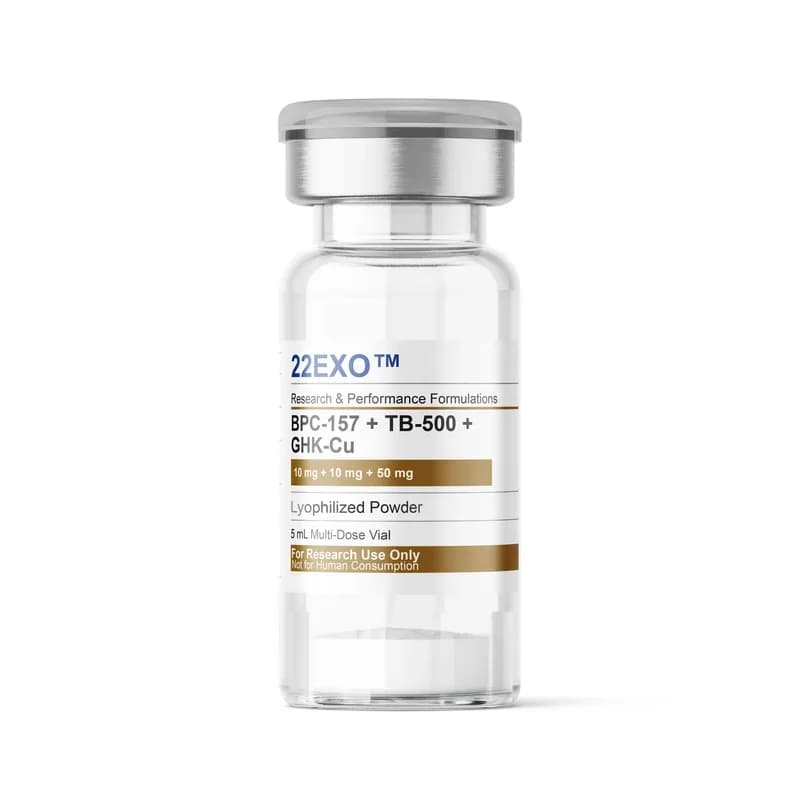
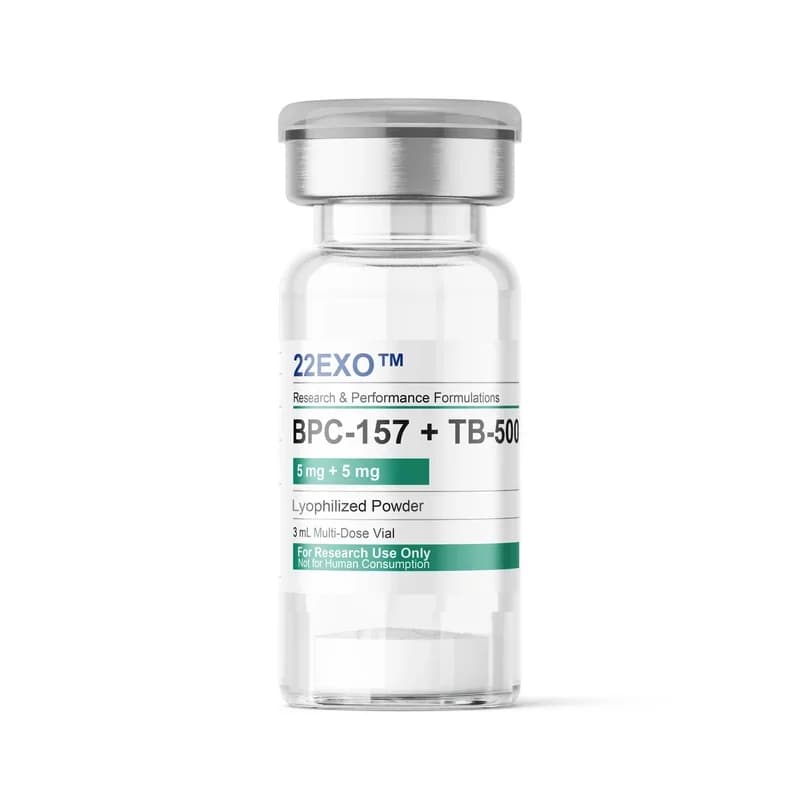
BPC-157 + TB-500 Blend (5mg/5mg)
Research gradeThe premier tissue repair combination — 5mg BPC-157 provides localized cytoprotective signaling while 5mg TB-500 delivers systemic angiogenesis and repair signals to remote injury sites.
- Target purity ≥98%
- COA pending — lot documentation on request
- Cold packs when needed
You save $24.00 per vial
Free standard shipping on orders over $200.00 · Discreet packaging
| 1 vial | $94.00 | |
| 2 vials | $89.30 | Save 5% |
| 3 vials | $84.60 | Save 10% |
| 4 vials | $79.90 | Save 15% |
| 5–9 vials | $75.20 | Save 20% |
| 10+ vials | $70.50 | Save 25% |
Tiers apply to the quantity on each cart line; a Subscribe & Save line is priced separately from a one-time line.
- Target purity
- ≥98% (COA pending)
- Strength
- 5mg/5mg
- CAS
- 137525-51-0 / 77591-33-4
- Formula
- C62H98N16O22 / C212H350N56O78S
- Form
- Lyophilized Powder
- Vial
- 3 mL Multi-Dose Vial
Third-party certificate of analysis for the current lot is pending. Email support@22exo.com to request lot documentation before ordering.
Ordering for an institution? Volume pricing and purchase orders are available. Wholesale program → · Contact support
Commonly researched together
Hand-picked companion compounds for research alongside BPC-157 + TB-500 Blend (5mg/5mg).
Total for 3 items: $197.49
Overview
The BPC-157 + TB-500 blend combines two of the most extensively studied tissue repair peptides in a single preparation designed for synergistic wound healing and systemic regenerative research. BPC-157 (Body Protection Compound-157, 5mg) provides locally concentrated cytoprotective and angiogenic signaling through VEGF upregulation, FAK-paxillin pathway activation, and NO system modulation, while TB-500 (synthetic Thymosin Beta-4, 5mg) provides systemic reach through its unique property of distributing from the injection site to remote injury locations. Together they address tissue repair from complementary molecular angles: BPC-157 driving localized growth factor signaling and GI/tendon-specific protective mechanisms, TB-500 providing G-actin sequestration, cardiac progenitor cell activation, and systemic angiogenesis. This combination is the most commonly studied dual-peptide protocol in the tissue repair research literature.
Mechanism
BPC-157 activates VEGF, EGF, and NGF expression and drives JAK-2/STAT-3 and FAK-paxillin signaling pathways for cell migration and wound granulation. Its modulation of the NO system provides both vascular and anti-inflammatory benefits. TB-500 simultaneously buffers G-actin via its WH2 domain to accelerate cell migration velocity, upregulates VEGF and its receptors, and activates CXCR4/SDF-1α stem cell homing. The combination produces additive VEGF upregulation through two independent pathways (BPC-157's transcriptional mechanism and TB-500's receptor-level upregulation), potentially creating synergistic angiogenic drive. TB-500's systemic distribution means the regenerative signal reaches remote injury sites simultaneously with BPC-157's locally dominant protective activity. The different cellular targets (BPC-157: endothelial cells, fibroblasts, enterocytes; TB-500: cardiomyocytes, corneal cells, neurons) create a complementary, multi-tissue repair signal.
Published research
- 1BPC-157 component: Accelerated healing of transected tendons, GI mucosal protection, and neuroprotection across 100+ published studies (Sikiric et al., 1993–2018; Staresinic et al., 2003)
- 2TB-500 component: Significant cardiac repair with stem cell activation, angiogenesis, and corneal wound healing across multiple tissue models (Smart et al., 2007; Malinda et al., 1999)
- 3Combination rationale: Complementary VEGF upregulation pathways — BPC-157 through transcriptional upregulation, TB-500 through receptor sensitization — providing additive angiogenic drive
- 4Systemic distribution advantage: TB-500 reaches remote injury sites while BPC-157 provides localized protective signaling, creating full-system coverage from a single injection site
- 5The BPC-157 + TB-500 protocol is the most referenced combination in tissue repair peptide literature, with extensive anecdotal and preclinical support for its synergistic rationale
Methodology note: This product summary references published preclinical and clinical research. 22EXO does not make therapeutic claims. All compounds are sold strictly for laboratory and research applications.
Disclaimer: For in-vitro laboratory research use only. Not for human or veterinary use. By purchasing, you agree to our terms of service and confirm that this product will only be used for legitimate research purposes.
Customer reviews
No reviews yet for BPC-157 + TB-500 Blend (5mg/5mg).
Bought it? Be the first to share how it arrived — packaging, documentation, solubility. Reviews from purchasers are marked Verified Buyer.
Related research
All articlesPolypeptide vs Peptide vs Protein: Definitions, Sizes, and Why It Matters
The terms peptide, polypeptide, and protein are used interchangeably in casual conversation and inconsistently in the primary literature. The distinctions are real, biologically meaningful, and directly relevant to how researchers synthesize, store, and handle these molecules in the lab.
10 min readHealing & RecoveryPeptides Near Me: Where Research Labs Source Peptides in Major U.S. Metros
When a lab technician types 'peptides near me,' they are almost certainly asking the wrong question. Here is how research institutions across the ten largest U.S. metros actually source RUO peptides — and why geography matters less than cold-chain logistics.
10 min readHealing & RecoveryAre Research Peptides Legal in the U.S.? RUO and FDA
Research peptides occupy a defined but frequently misunderstood legal category in the U.S. The answer depends on which law applies, what the peptide is, who is buying it, and what it is labeled for.
10 min readHealing & RecoveryHow to Reconstitute Peptides: Step-by-Step Lab Protocol
Lyophilized peptides arrive as dry powder or cake. Research-chemical reconstitution requires the right solvent, the slow-stream technique, and concentration math to keep a research solution intact.
9 min readHealing & RecoveryWhy BPC-157, TB-500, and GHK-Cu Get Stacked Together: The Mechanism Map
Three peptides, three different cellular processes, one tissue-repair logic. The combination has become one of the most-used research stacks. Here is the mechanistic case for why — and what the evidence actually supports.
10 min readHealing & RecoveryThymosin Beta-4 and the Actin Pool: What TB-500 Actually Does at the Cellular Level
TB-500 is a fragment of thymosin beta-4, a 43-residue protein whose primary cellular role is sequestering G-actin monomers. The mechanism is unusual, the literature is dense, and the therapeutic implications are still being worked out.
10 min read