Peptide Reconstitution and Handling: A Researcher's Guide to Not Ruining Expensive Compounds
Peptide reconstitution done wrong can degrade a significant fraction of your compound before any experiment starts. A practical guide covering the chemistry, math, and technique that protect expensive research peptides.
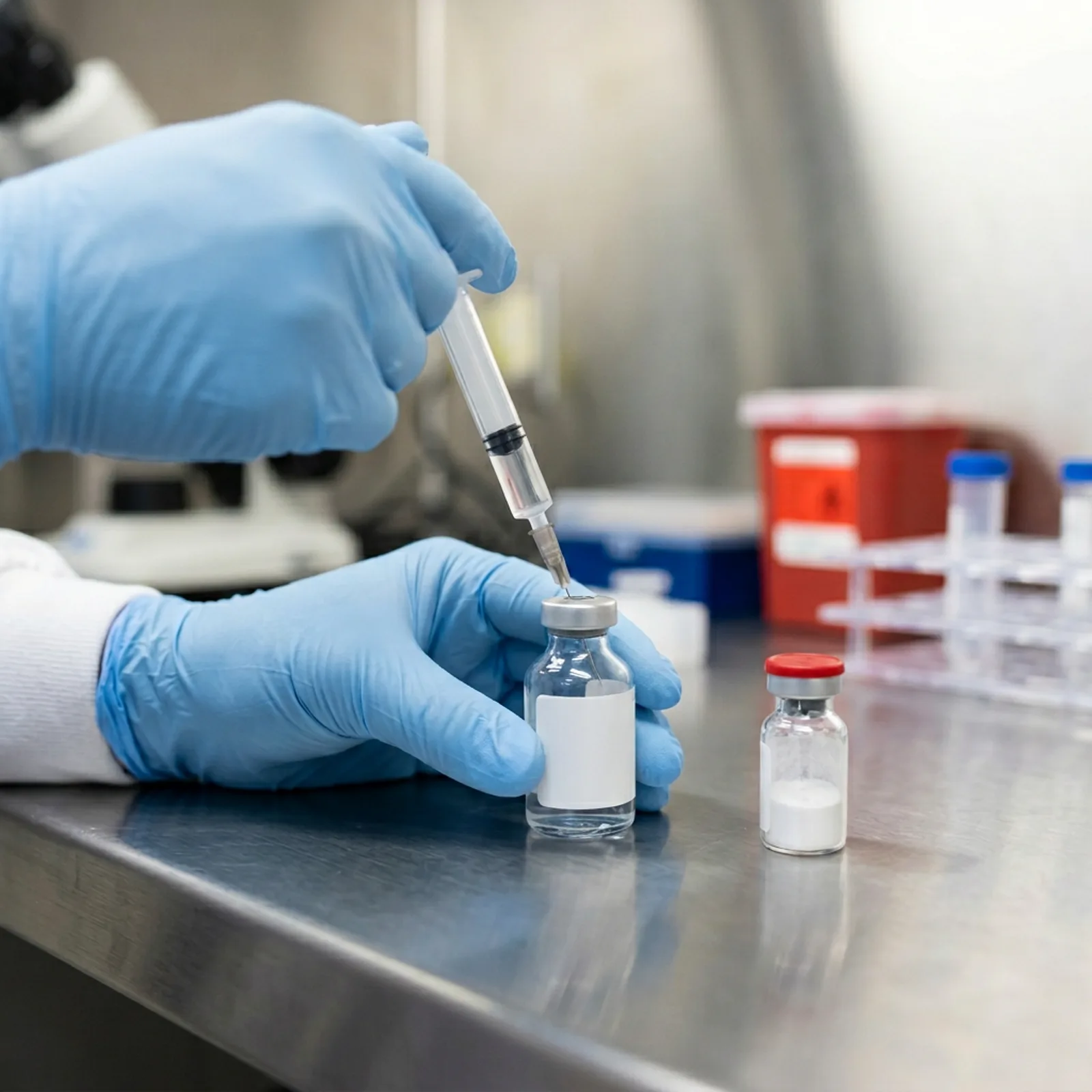
Peptides are not forgiving compounds. They arrive as lyophilized powders — freeze-dried — precisely because that form is far more stable than solution. The moment you add liquid, the clock starts. Handle the reconstitution poorly and you could degrade a significant fraction of your compound before a single experiment begins. Given that research peptides aren't cheap and that accurate dosing depends on compound integrity, this process deserves more serious attention than most researchers give it.
This guide covers the chemistry behind why peptides degrade, the practical steps to minimize it, and the math required to actually know what concentration you're working with.
Why Lyophilized Peptides Are Stable — and Reconstituted Ones Aren't
In the dry, lyophilized state, most peptides are stable for years when properly stored. The freeze-drying process removes water — the primary medium through which chemical degradation reactions proceed. Without water, hydrolysis can't occur, oxidation is slowed dramatically, and the peptide chain is essentially locked in place.
Add water and you reactivate all the degradation pathways. Manning and colleagues published a comprehensive review of protein and peptide stability in Pharmaceutical Research (2010) that documented the major chemical threats in aqueous solution:
- Hydrolysis: Water cleaves peptide bonds — particularly at aspartyl-glycine sequences and at the N-terminus. Rate is strongly pH-dependent, with most peptides most stable between pH 4–6 in solution.
- Oxidation: Methionine, cysteine, tryptophan, and histidine residues are susceptible to oxygen-mediated degradation. Peptides containing these residues degrade faster in oxygenated environments.
- Deamidation: Asparagine and glutamine residues spontaneously lose an amide group, altering the peptide's charge and often its biological activity. Temperature and pH both influence deamidation rate.
- Aggregation: Peptides can cluster into non-covalent or covalent assemblies — often invisible to the naked eye — that reduce the functional concentration of monomeric active compound.
Hawe and colleagues (from the Jiskoot/Wiggenhorn/Mahler group, published in the Journal of Pharmaceutical Sciences, 2012) conducted extensive work on aggregation and particulate formation in therapeutic protein formulations, highlighting that freeze-thaw cycles are among the most common triggers for aggregation in reconstituted peptides. The mechanical stress of ice crystal formation and the concentration changes that occur at phase boundaries during freezing can disrupt secondary and tertiary structure — even in relatively small peptides.
The takeaway: every freeze-thaw cycle is a degradation event. Minimize them.
Bacteriostatic Water vs. Sterile Water: Not a Preference — a Principle
This is where a lot of researchers make their first significant mistake. Sterile water for injection and bacteriostatic water (BAC water) are not equivalent, and the difference matters for multi-use research vials.
Sterile water is exactly what it sounds like: water that has been sterilized but contains no preservatives. It is designed for single-use. Once the vial seal is broken, it has no protection against bacterial contamination. For a research compound you'll draw from repeatedly over 4–6 weeks, sterile water is inappropriate.
Bacteriostatic water contains 0.9% benzyl alcohol — a preservative that inhibits bacterial growth in the vial, allowing safe multi-dose use for up to 28 days after reconstitution (when properly refrigerated). The benzyl alcohol concentration is well below levels that cause peptide degradation, though some highly sensitive peptides may require verification.
The practical rule: unless you have a specific reason to use sterile water (single-use protocol, known benzyl alcohol incompatibility), use bacteriostatic water. The contamination risk from multi-dose sterile water vials is real — bacterial proteases will degrade your peptide and create a safety issue simultaneously.
One exception worth noting: some peptides require an acetic acid solution or another specific diluent for proper dissolution. Poorly soluble peptides (particularly those with hydrophobic sequences) sometimes need a small volume of 0.1% acetic acid added first as a solvent before dilution with BAC water. If your reconstituted peptide doesn't go into solution clearly after gentle swirling, this may be the approach needed.
The Reconstitution Calculation
You need to know your concentration before you can dose accurately. The math is straightforward, but getting it wrong defeats the purpose of having a pure, potent compound.
The formula:
Volume of BAC water to add (mL) = Peptide mass (mg) ÷ Desired concentration (mg/mL)
Working with a specific example — say, a 5mg vial of BPC-157 like 22EXO's BPC-157 5mg:
- If you add 1 mL of BAC water: concentration = 5mg/mL = 5,000 μg/mL
- If you add 2 mL: concentration = 2.5mg/mL = 2,500 μg/mL
- If you add 5 mL: concentration = 1mg/mL = 1,000 μg/mL
Many researchers prefer a 2 mL reconstitution for 5mg peptide vials — producing 2,500 μg/mL — because it gives manageable volumes for standard insulin syringes. With a standard U-100 insulin syringe (100 units = 1 mL), each unit = 0.01 mL = 25 μg at that concentration.
For a larger, 43-amino-acid peptide like TB-500 5mg, the same math applies. TB-500 in particular benefits from careful reconstitution technique given its longer sequence and moderate solubility.
For peptides like CJC-1295 No-DAC 5mg, a 2.5 mL reconstitution yielding 2mg/mL = 2,000 μg/mL is a common starting point for research protocols.
Write your calculations down before you reconstitute. Don't do this from memory in the moment.
Step-by-Step Reconstitution Technique
The physical process of reconstitution seems simple but contains several steps where degradation can occur if you're not careful.
- Equilibrate to room temperature. Take your peptide vial out of the refrigerator/freezer and let it reach room temperature before opening. Cold peptides exposed to ambient humidity will condense moisture onto the powder — introducing water before you control the volume.
- Disinfect the rubber septa. Wipe both the peptide vial septum and the BAC water vial septum with 70% isopropyl alcohol. Let it air-dry for 30 seconds before inserting a needle — don't push alcohol into the vial.
- Draw the BAC water. Use a syringe sized appropriately for your target volume. Draw slowly to minimize bubbles.
- Inject along the vial wall, not onto the powder. This is critical. Insert the needle and tilt it so the stream of water runs down the inside glass wall of the vial — not directly onto the lyophilized cake at the bottom. Forceful injection onto the powder causes mechanical shear that can damage peptide structure. The goal is to let the powder dissolve slowly into the surrounding liquid.
- Gently swirl, do not vortex. Once the water is in, gently swirl the vial with a rolling motion until the powder dissolves. The solution should turn uniformly clear. Do not shake vigorously — bubbles and mechanical turbulence cause aggregation. Never vortex.
- Inspect before use. Clear solution with no visible particles or cloudiness is what you want. If the solution is cloudy, unexpectedly colored, or has visible particulates, do not use it.
Storage After Reconstitution
Reconstituted peptides should be refrigerated at 2–8°C (36–46°F) and typically used within 4–6 weeks when reconstituted in bacteriostatic water. This timeline assumes proper sterile handling with each draw — alcohol-wiping the septum every time you insert a needle, using a sterile needle for each draw, and keeping the vial sealed between uses.
Do not freeze reconstituted peptides. This is worth stating clearly because it's counterintuitive — you might assume colder is better for stability. For reconstituted solutions, freezing triggers the aggregation mechanisms documented by the Hawe group: ice crystal formation creates physical stress on the peptide, and concentration changes during freeze-thaw alter the local chemical environment in ways that promote aggregation and structural damage.
Lyophilized (unreconstituted) peptides are a different story. Dry peptide vials should be stored at -20°C for long-term storage (months to years) and at 4°C for short-term use (weeks). Protect from light. Keep vials sealed until reconstitution day.
Signs Your Peptide Has Degraded
Even with perfect technique, peptides have a shelf life in solution. How do you know when a reconstituted vial is no longer suitable for research?
- Cloudiness or turbidity. A clear peptide solution that has become cloudy indicates aggregation — particles of misfolded or aggregated peptide are scattering light. This material is not reliably active and should be discarded.
- Visible precipitate. Small particles, flakes, or a film on the inner glass indicate significant aggregation or precipitation. Discard.
- Color change. Most peptide solutions are colorless to slightly yellowish. Unexpected color development (browning, green tint) indicates oxidative degradation or contamination. Discard.
- Unusual odor. Though difficult to assess through a sealed rubber septum, microbial contamination sometimes produces detectable odors upon opening. Any vial that smells wrong should be discarded.
- Beyond the 4–6 week window with BAC water. Even without visible signs of degradation, the benzyl alcohol preservative's effectiveness has a defined timeframe. After 4–6 weeks, bacterial contamination risk increases regardless of appearance.
A Note on Dosing Math Integrity
One thing that undermines otherwise careful research is dosing imprecision that compounds over time. If your reconstitution volume was imprecise (you meant to add 2.0 mL but actually added 1.85 mL), your concentration is off from the start. If you're drawing with a U-100 syringe that's slightly air-bubbled, your delivered volume is different from intended. Over a multi-week protocol, these errors accumulate.
Solutions: use calibrated syringes, draw slowly to eliminate air bubbles, and double-check your reconstitution volume against a calibrated measurement if precision is critical to your research design. Document the reconstitution date, volume added, calculated concentration, and storage location for every vial.
Good experimental practice isn't separate from proper peptide handling — it's the same discipline applied at different scales. The careful technique that protects your compound also protects your data.
Frequently Asked Questions
Why should I use bacteriostatic water instead of sterile water for peptide reconstitution?
Sterile water contains no preservatives and is designed for single-use. Once the vial is opened, it has no protection against bacterial contamination — and bacteria produce proteases that degrade peptides. Bacteriostatic water contains 0.9% benzyl alcohol, which inhibits bacterial growth and allows safe multi-dose use from the same vial for up to 28 days when properly refrigerated. For any protocol requiring multiple draws over days or weeks, bacteriostatic water is the appropriate choice.
Should I freeze my reconstituted peptides?
No. Freezing reconstituted peptide solutions causes ice crystal formation that physically stresses the peptide structure, and concentration changes during freeze-thaw cycles promote aggregation and structural damage — mechanisms documented by Hawe and colleagues in the Journal of Pharmaceutical Sciences (2012). Store reconstituted peptides refrigerated at 2-8°C and use within 4-6 weeks. Only lyophilized (dry, unreconstituted) peptides should be stored frozen at -20°C for long-term preservation.
How do I calculate the concentration of a reconstituted peptide?
Divide the peptide mass by the volume of liquid added. For a 5mg vial: adding 1mL gives 5mg/mL (5,000 μg/mL); adding 2mL gives 2.5mg/mL (2,500 μg/mL); adding 5mL gives 1mg/mL (1,000 μg/mL). Many researchers use 2mL for 5mg vials — producing 2,500 μg/mL — because this gives convenient volumes for standard U-100 insulin syringes where each unit equals 25 μg.
What are signs that a reconstituted peptide has degraded?
Key indicators include cloudiness or turbidity (indicating aggregation), visible precipitates or particles, unexpected color changes (browning or unusual tints from oxidative degradation), unusual odors suggesting contamination, and any vial beyond the 4-6 week post-reconstitution window with bacteriostatic water. A solution that was previously clear and has become cloudy should always be discarded.
Why should I inject water along the vial wall rather than directly onto the peptide powder?
Forceful injection directly onto the lyophilized peptide powder causes mechanical shear stress that can damage peptide structure — breaking or misfolding the amino acid chain. Directing the water stream down the inner glass wall of the vial allows the powder to dissolve gradually as the liquid level rises, without mechanical trauma. Similarly, the vial should only be gently swirled after water addition — never vortexed or vigorously shaken — as mechanical turbulence promotes aggregation.