How to Evaluate Peptide Purity: HPLC Reports, Mass Spec, and Red Flags to Watch For
Reading a peptide certificate of analysis competently requires understanding what HPLC purity actually measures, what mass spec confirms, and what missing data should make you walk away.
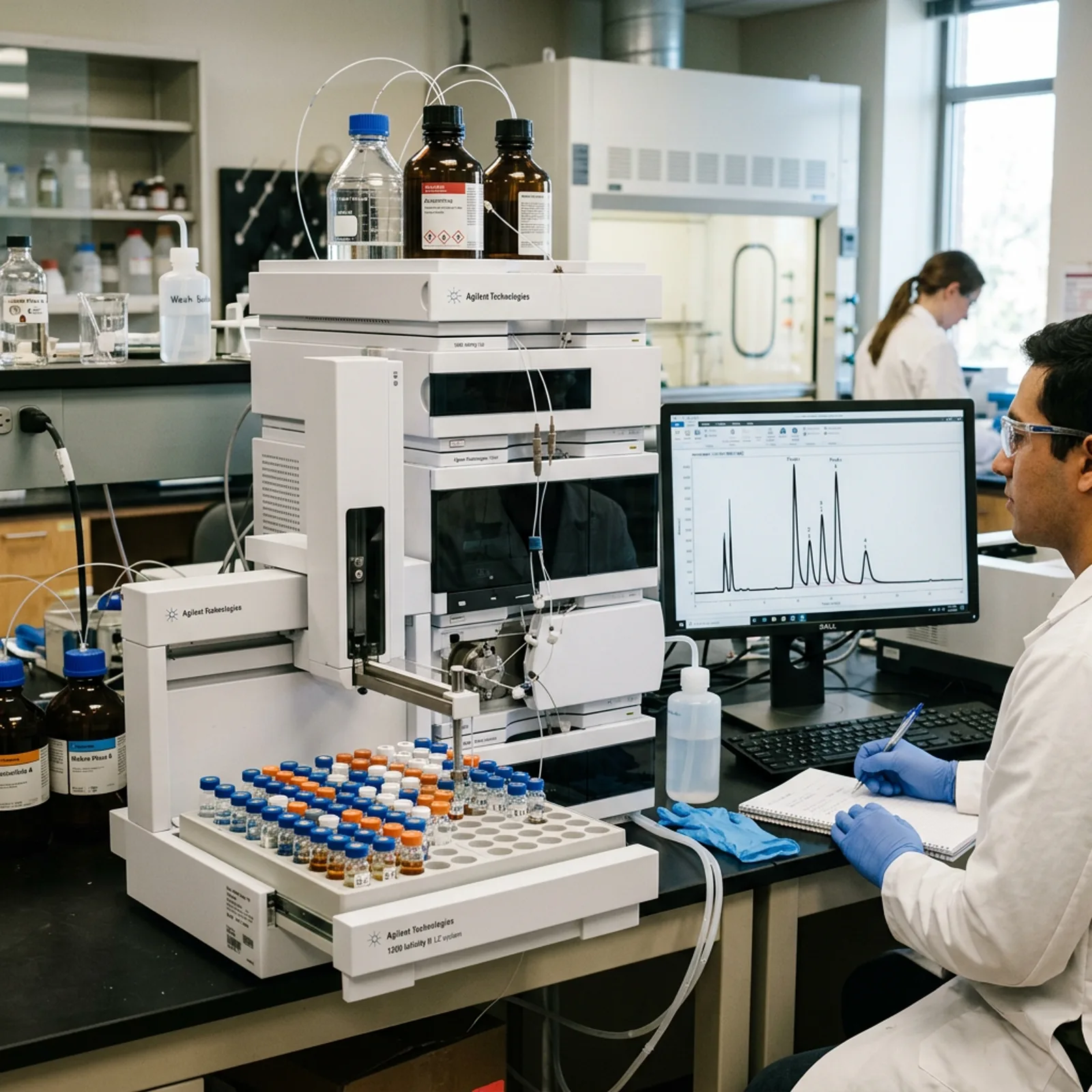
You've found a peptide supplier. They claim 99% purity. There's a certificate of analysis attached — a PDF with some numbers on it, maybe a chromatogram, maybe some molecular weight data. The question is: do you actually know what you're looking at?
Most people don't — and that's not an insult. These analytical documents are dense, and suppliers know that opacity works in their favor. This guide is about changing that. If you research peptides seriously, reading a COA competently isn't optional.
Why Purity Matters More Than You Might Think
When a peptide vial is labeled "BPC-157 5mg," that describes what's supposed to be in the vial. What's actually in it depends on synthesis quality, purification process, and whether the supplier bothered to test independently. Peptide synthesis is a chemical process with byproducts — deletion sequences (where an amino acid is skipped), truncated fragments, oxidized residues, racemized amino acids, residual solvents, and protecting group remnants can all end up in the final product.
A compound with 80% purity isn't a less potent version of the same compound. It's that compound plus 20% of unknown material — some of which may be biologically inactive, some of which may be subtly active in unintended ways. In a research context, that ambiguity contaminates your data. In any application, it's simply not what you paid for.
HPLC: The Primary Purity Measurement
High-Performance Liquid Chromatography (HPLC) is the industry standard for peptide purity determination. The version used for peptides is almost universally Reversed-Phase HPLC (RP-HPLC), where the stationary phase is nonpolar and the mobile phase is a polar solvent — typically water/acetonitrile with a modifier like trifluoroacetic acid (TFA).
Here's how it works: the peptide sample is injected and carried through a column by the mobile phase. Different molecules travel at different speeds depending on their hydrophobicity — hydrophobic compounds interact more strongly with the nonpolar stationary phase and elute later. As compounds exit the column, a UV detector (typically set at 214 nm, the absorption wavelength of the peptide bond) measures absorbance over time, generating a chromatogram.
The chromatogram is a plot of UV absorbance versus time. Each peak represents one (or more) components. The area under each peak correlates with the quantity of that component. Purity is calculated as:
Purity % = (Area of main peptide peak ÷ Total area of all peaks) × 100
So when a supplier says 98% purity by HPLC, they mean the target peptide's peak accounts for 98% of the total peak area. The remaining 2% is everything else — impurities, related substances, degradation products.
What a Good HPLC Chromatogram Looks Like
The main peak should be:
- Dominant — visually the largest feature by a wide margin
- Well-defined with a sharp, symmetrical shape
- Consistent with the expected retention time for that peptide
- Rising from and returning cleanly to a stable baseline
Impurity peaks should be minimal — small, well-separated from the main peak, and clearly distinguished. The baseline should be flat and stable, not drifting or noisy.
Red Flags in HPLC Reports
Several things should raise questions when reviewing a chromatogram:
- Peak tailing or fronting. A peak that drags out asymmetrically to the right (tailing) or has a sharp leading edge with a gradual trailing edge (fronting) can indicate column overloading, poor method optimization, or co-eluting impurities hiding inside the main peak shape. A supplier reporting 98% purity with significant peak tailing is giving you a less reliable number than that figure suggests.
- Multiple unresolved peaks near the main peak. If there are several peaks clustered together, the integration software may be drawing boundaries in ways that flatter the purity number.
- No chromatogram at all — just a percentage. This is the biggest red flag. A purity claim without the supporting chromatogram is unverifiable. Always ask for the actual graphical output.
- Missing retention time data. The COA should specify the retention time of the main peak. Without it, you can't cross-reference the HPLC method or verify consistency across batches.
- Unusually short run times. A peptide like TB-500 (43 amino acids) requires adequate chromatographic separation to resolve related impurities. An HPLC run that's over in 5 minutes almost certainly hasn't achieved the resolution needed.
Mass Spectrometry: Confirming Identity, Not Purity
Here's a distinction that trips up almost everyone: HPLC measures purity (how much of the mixture is the target peptide). Mass spectrometry confirms identity (whether the correct molecule is present at all).
Mass spec works by ionizing the peptide and measuring the mass-to-charge ratio (m/z) of the resulting ions. For a given peptide sequence, the theoretical molecular weight is calculable from the amino acid composition. If the measured m/z matches the theoretical value, the molecule has the correct molecular weight — which is strong evidence for the correct sequence, though not absolute proof of it (different sequences can share the same molecular weight).
ESI-MS (electrospray ionization mass spectrometry) is the most common technique for peptide identity confirmation. Peptides generate multiple charge states under ESI conditions, producing a characteristic pattern of peaks across the m/z spectrum. An experienced analyst can confirm identity by matching this pattern to the theoretical distribution.
A complete peptide COA should include both HPLC purity data and mass spec identity data. These are complementary, not interchangeable. A peptide can:
- Show correct mass but low purity (the right molecule exists but is contaminated)
- Show high HPLC purity but incorrect mass (a different molecule is highly concentrated)
- Show both correct mass and high purity (what you actually want)
If a supplier provides only one of these, press for the other.
What “>98% Purity” Actually Guarantees — and What It Doesn't
A 98% HPLC purity result means, specifically, that by UV absorbance at 214 nm, the target peptide accounts for 98% of all UV-absorbing species detected under those chromatographic conditions. Several important caveats apply:
- Different compounds absorb UV differently. HPLC purity is an area-percent measurement, not a mass-percent measurement. A contaminant that absorbs more strongly at 214 nm will be overrepresented; one that absorbs weakly will be underrepresented. The two aren't directly equivalent.
- Residual solvents and counter-ions aren't measured by UV-HPLC. TFA (trifluoroacetic acid), acetonitrile, and other process-related impurities may be present and aren't captured in the peptide purity number.
- Enantiomeric purity isn't addressed. Amino acids are chiral — they have L and D forms. Standard synthesis can produce some D-amino acid contamination (racemization), which won't necessarily separate under standard RP-HPLC conditions. Chiral HPLC is a separate analysis.
- Water content matters for dosing calculations. Lyophilized peptides absorb atmospheric moisture. A peptide vial labeled 5mg based on the synthesis mass may contain somewhat less active compound depending on water content — relevant for precise dosing calculations.
None of this invalidates HPLC purity as a metric. It's still the best standard tool available. But understanding what the number does and doesn't tell you is part of being a critical consumer of this data.
Third-Party Testing vs. In-House Testing
There's a meaningful difference between a COA generated by the manufacturer's own lab and one generated by an independent, accredited third-party laboratory. Both can be legitimate. But self-generated COAs have an obvious conflict of interest — the entity being evaluated is also doing the evaluation.
Third-party COAs from ISO-accredited labs (look for ISO 17025 certification for analytical testing laboratories) carry significantly more weight. The accreditation means the lab has demonstrated competency through external assessment, uses validated methods, and maintains documented quality systems. A supplier willing to submit their products to independent third-party analysis and publish the results is making a meaningful transparency commitment.
22EXO products are backed by third-party analytical verification. For compounds like BPC-157 5mg, CJC-1295 DAC 5mg, and TB-500 5mg, the COA reflects independent HPLC purity data and mass spec confirmation. If you're ever uncertain about a document, ask whether it originated from a third-party facility and request the testing lab name — a reputable supplier won't have any issue providing that information.
Specific Red Flags for Peptide COAs
Collect enough peptide COAs and patterns emerge among the ones that shouldn't be trusted:
- Purity listed as exactly 99.00% — real analytical results are rarely this round
- A single page with just a molecular weight, sequence, and purity number — no chromatogram, no mass spec trace
- The retention time changes significantly between batches without explanation
- Mass spec results presented as only the monoisotopic mass without the full spectrum or charge state distribution
- COA date that predates the supposed manufacture date
- Different HPLC methods used across batches (making batch-to-batch purity comparisons meaningless)
- No information on the testing laboratory — name, location, or accreditation status
The Practical Standard
For serious research applications, a minimum acceptable COA includes: HPLC purity ≥98% with the full chromatogram showing retention time and integration data; mass spectrometry confirmation showing the correct molecular weight with the m/z spectrum; and identification of the testing laboratory with some indication of third-party independence.
Anything less than that isn't a complete quality document — it's a partial one, and the missing elements are almost always the ones that would reveal the problems.
The research literature underpinning compounds like BPC-157 and CJC-1295 used characterized reference standards. Replicating those conditions in your own research requires starting with comparable material quality. A 98% pure peptide from a verified COA is not the same research tool as an unlabeled compound with a self-reported purity number and no supporting data.
Frequently Asked Questions
What does 98% HPLC purity actually mean for a peptide?
An HPLC purity of 98% means the target peptide's chromatographic peak accounts for 98% of the total UV-absorbing peak area detected at 214 nm under the specific analytical conditions used. It does not guarantee 98% by mass, does not account for residual solvents or moisture, and does not confirm enantiomeric purity. It is, however, the best standard purity metric available and appropriate for research-grade work when accompanied by mass spec identity confirmation.
What is the difference between HPLC purity and mass spec for peptides?
HPLC purity answers 'how much of the mixture is the target peptide' — it's a quantitative purity measurement. Mass spectrometry answers 'is the correct molecule present' — it confirms molecular identity by measuring mass-to-charge ratio and comparing to the theoretical molecular weight. A complete peptide COA needs both: HPLC for purity, mass spec for identity. They are not interchangeable.
What should I look for in a good peptide chromatogram?
The main peak should be dominant, sharp, and symmetrical with a stable baseline. It should have a consistent retention time matching the expected value for that peptide. Impurity peaks should be minimal and clearly separated from the main peak. Red flags include significant peak tailing or fronting, multiple unresolved peaks near the main peak, a drifting baseline, or an unusually short run time that suggests inadequate method resolution.
Is a third-party COA more reliable than an in-house one?
Generally yes. Third-party COAs from ISO 17025-accredited laboratories carry more weight because the testing facility is independent from the supplier and has been externally validated for analytical competency. Self-generated COAs can be legitimate, but they have an inherent conflict of interest. When evaluating a supplier, ask specifically whether COA testing is conducted by a named third-party laboratory.
What are the biggest red flags in a peptide certificate of analysis?
Key red flags include: no chromatogram provided (just a purity percentage), purity listed as a suspiciously round number like exactly 99.00%, no mass spectrometry data confirming the correct molecular weight, no testing laboratory name or accreditation information, retention times that vary significantly between batches without explanation, and COA dates that predate the manufacture date.