Bacteriostatic Water for Peptides: Sourcing and Sterility
Bacteriostatic water is sterile water plus 0.9% benzyl alcohol. That additive makes it safe for multi-dose lab use. Here is what it is, where U.S. labs source it, and how storage affects it.
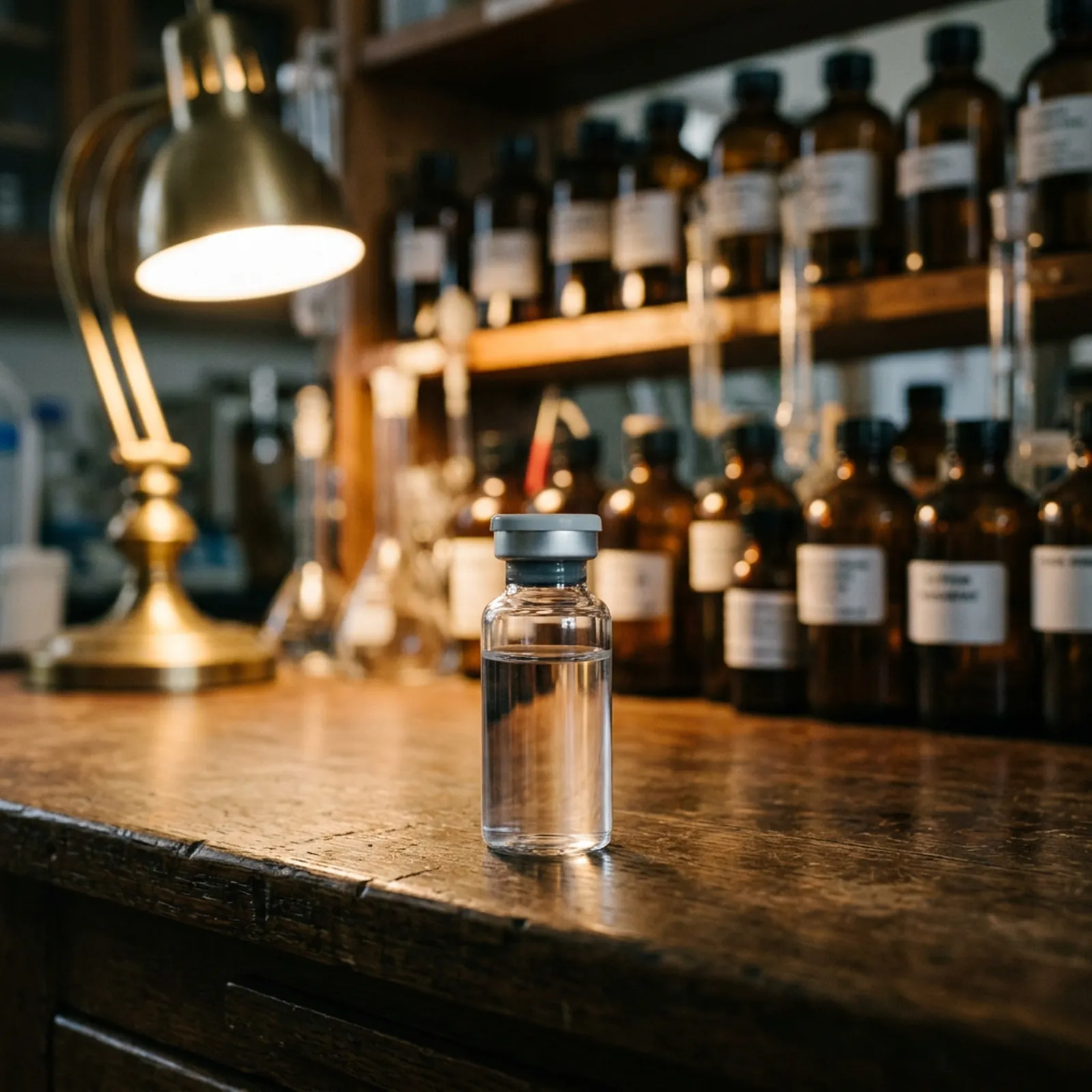
Bacteriostatic Water for Peptides: Sourcing, Storage, and Sterility
The 0.9% That Changes Everything
Bacteriostatic water and sterile water for injection are chemically nearly identical. Both start from water purified to USP standards — deionized, distilled, and filtered to remove pyrogens (endotoxins). Both are terminally sterilized. The entire functional difference between them is a single added component: bacteriostatic water contains 0.9% benzyl alcohol (9 mg/mL). Sterile water does not.
That 0.9% determines whether a multi-dose vial is appropriate for drawing multiple research samples across several weeks, or whether it must be treated as single-use and discarded after each session. Understanding why requires examining what actually happens when a needle passes through a rubber septum.
What Happens When the Seal Is Broken
A sealed, sterile vial is a closed system. The moment a needle penetrates the stopper, the interior connects to the external environment. The needle surface can carry microorganisms from skin or lab air. Air displaced from the syringe enters the vial headspace. Over multiple draws across a multi-day research protocol, these contamination inputs accumulate.
In a vial of plain sterile water, each puncture is a contamination event with no corrective mechanism. Standard pharmaceutical guidance classifies sterile water for injection as single-use: draw what is needed and discard. For a research lab running multi-day reconstitution workflows, this is both impractical and expensive.
Benzyl alcohol changes the equation. At 0.9% concentration, it disrupts microbial cell membranes and inhibits growth across a broad organism spectrum. USP Antimicrobial Effectiveness Testing (Chapter <51>) evaluates benzyl alcohol specifically against Staphylococcus aureus, Pseudomonas aeruginosa, Escherichia coli, Candida albicans, and Aspergillus brasiliensis. The standard requires ≥2 log reduction in bacterial count within 14 days and no increase in fungal count. Bacteriostatic water at 0.9% passes this test — which is what qualifies it for the multi-dose designation.
Benzyl Alcohol: Bacteriostatic, Not Bactericidal
The term is precise. At 0.9%, benzyl alcohol inhibits microbial growth and reproduction; it does not reliably kill every organism that enters the vial. It prevents the population from expanding to levels that would affect research solution integrity or downstream assay results. This distinction has two practical implications.
First, good aseptic technique remains non-negotiable regardless of solvent choice. Wiping the stopper with 70% isopropanol before each needle insertion, using only sterile needles and syringes, and working on a clean bench are the first line of defense. Bacteriostatic water supplements that defense — it does not substitute for it.
Second, the preservative protection has a time limit. USP guidance for multi-dose vials with 0.9% benzyl alcohol sets 28 days post-opening as the outer bound of reliable antimicrobial effectiveness under normal handling conditions. After 28 days, discard the vial and open a new one. Mark the open date on every vial, without exception.
U.S. Sourcing for Research Labs
The reference-standard source for bacteriostatic water in U.S. research settings is the Pfizer (formerly Hospira) bacteriostatic water for injection, USP, in 30 mL multi-dose vials. These are manufactured under FDA current Good Manufacturing Practice (cGMP) regulations, carry lot numbers and expiration dates, and are endotoxin- and sterility-tested by the manufacturer. The 30 mL format is well-matched to typical research lab throughput: sufficient volume for multiple reconstitutions across a multi-week protocol, manageable within the 28-day window for an active lab.
Distribution channels in the U.S. include pharmaceutical wholesalers (AmerisourceBergen, McKesson), medical supply distributors, and select laboratory reagent suppliers. Veterinary-labeled bacteriostatic water products manufactured to comparable standards are also available for research use.
What to avoid: non-pharmaceutical-grade preparations without explicit sterility certification, products without a visible lot number and expiration date, and any preparation where benzyl alcohol concentration is unspecified. Concentrations above approximately 1.5% begin to affect the solubility behavior of some peptides and can alter secondary structure in larger molecules.
22EXO is adding bacteriostatic water (30 mL, pharmaceutical grade) to its research supplies catalog at /product/bacteriostatic-water-30ml for labs that want to source solvent and peptides from a single verified supplier. This product will carry the same lot-level documentation standard as all 22EXO research chemicals.
Storage Conditions for BAC Water
Unopened bacteriostatic water vials store at controlled room temperature — 20–25°C — away from direct light. Refrigeration at 2–8°C is acceptable for opened vials and may marginally extend the preservative activity, but the 28-day post-opening rule applies regardless of temperature.
Do not freeze bacteriostatic water. Freezing causes benzyl alcohol to partition unevenly within the aqueous phase. Upon thawing, the benzyl alcohol concentration may not redistribute uniformly, introducing uncertainty about the actual preservative concentration delivered to each research solution prepared from that vial. An unevenly preserved solvent can give false confidence about multi-dose vial safety.
Why Saline Is Not a Substitute for Research Peptide Reconstitution
Normal saline (0.9% NaCl) carries no antimicrobial protection, giving it the same single-use limitation as plain sterile water. More importantly, the ionic strength of saline can interfere with peptide solubility. Several research peptides — particularly those with net positive charge at neutral pH — are more soluble in low-ionic-strength aqueous solution than in physiological saline. Using saline as the reconstitution solvent can reduce effective working concentration and increase aggregation risk compared to bacteriostatic water.
Saline appears in some research protocols as a dilution vehicle after initial reconstitution in bacteriostatic water, bringing the total volume up for volume-specific assay delivery. This is distinct from using saline as the primary reconstitution solvent and is a reasonable practice. Do not conflate the two applications.
Does Benzyl Alcohol Interfere With Research Assays?
At the concentrations relevant to standard peptide research protocols, benzyl alcohol is generally considered an inert spectator in most assay systems. The math: bacteriostatic water at 0.9% benzyl alcohol used to prepare a 2 mg/mL peptide stock introduces 9 mg/mL benzyl alcohol into the stock. A 1:100 dilution of that stock in assay media brings benzyl alcohol to approximately 90 mcg/mL in the working well. Published cytotoxicity thresholds for benzyl alcohol in most mammalian cell lines fall in the 500–2,000 mcg/mL range — providing 5- to 20-fold safety margin at this dilution level.
For sensitive cell-viability or proliferation assays, calculate the final benzyl alcohol concentration in each well explicitly and compare to your specific cell line's tolerance data. If your protocol requires benzyl-alcohol-free conditions, reconstitute in sterile water and use the full volume within 24 hours, or prepare single-use frozen aliquots from the lyophilized peptide.
Bacteriostatic Water and Regulatory Framing
Bacteriostatic water for injection is an FDA-regulated pharmaceutical product when purchased through licensed pharmaceutical channels. Research laboratories acquiring it through pharmaceutical distributors receive a product manufactured under cGMP with documented sterility and endotoxin testing — a substantially stronger quality baseline than general laboratory-grade reagent water.
The research-chemical reconstitution context for this solvent is Research Use Only. All 22EXO peptides — including BPC-157 (5 mg) and TB-500 (5 mg), both certified HPLC ≥98% with COA on every batch — are supplied strictly for non-clinical, in-laboratory research use. Reconstitution with bacteriostatic water described here applies to in-vitro research solution preparation, not to any human or veterinary application.
For the full technical reconstitution protocol covering solvent addition technique, storage windows, and common preparation errors, see How to Reconstitute Peptides: Step-by-Step Lab Protocol.
Managing BAC Water Across Multiple Research Protocols
A research lab running concurrent peptide reconstitution workflows needs a systematic approach to solvent management. Three practices maintain bacteriostatic water quality across experiments.
One vial per workflow group. If multiple researchers reconstitute peptides on overlapping schedules, sharing a single BAC water vial without centralized tracking creates ambiguity about puncture count and open date. Assigning a dedicated vial per project — with open date and puncture tally on the label — eliminates that ambiguity.
Pre-equilibrate before drawing. Drawing cold bacteriostatic water (stored at 2–8°C) into a room-temperature syringe causes minor condensation on the barrel. Letting the BAC water vial equilibrate for 15–20 minutes at room temperature before drawing improves volumetric accuracy and technique consistency.
Discard unused drawn volume. Any solvent drawn into a syringe but not used in a reconstitution should be discarded. A needle that entered the syringe has passed through air and may have contacted other surfaces. Returning it to the vial reintroduces contamination risk.
Recognizing a Compromised BAC Water Vial
Bacteriostatic water should remain clear and colorless throughout its full use window. Visible particulates, turbidity, or discoloration indicate the vial is compromised and should be discarded immediately. Particulates typically indicate microbial overgrowth — the benzyl alcohol was overwhelmed, or aseptic technique failed. Neither condition is recoverable; open a new vial.
If the BAC water vial is clear but the reconstituted peptide solution is cloudy, the problem originates with the peptide — incomplete dissolution or aggregation — not the solvent. An additional 10 minutes of gentle bench-temperature inversion resolves most peptide dissolution issues without any modification to the solvent approach.
Compatibility Notes for Common Research Peptides
Bacteriostatic water is compatible with the large majority of commonly studied research peptides at standard stock concentrations:
- GHK-Cu: Dissolves readily; the resulting research solution is characteristically blue from the copper(II) complex. A colorless GHK-Cu solution indicates compromised copper loading — a quality issue to flag with the supplier.
- Ipamorelin and CJC-1295: Both dissolve cleanly in BAC water at room temperature. CJC-1295 with DAC (drug affinity complex) can be slower to dissolve at concentrations above 2 mg/mL; the slow inversion protocol applies.
- Epithalon (tetrapeptide, Ala-Glu-Asp-Gly, 4 residues): Dissolves near-instantaneously in BAC water at any standard research concentration.
- Thymosin Alpha-1 (28 residues): Dissolves readily but is sensitive to oxidation in aqueous solution. Use the reconstituted research solution within 14 days and store in amber vials or foil-wrapped clear vials away from light.
All 22EXO research peptides ship as lyophilized powder in sealed glass vials, certified HPLC ≥98% with COA on every batch, and labeled for Research Use Only. Reconstitution with bacteriostatic water as described throughout this guide applies to non-clinical, in-laboratory research preparation only — not to human or veterinary use.
Frequently Asked Questions
What is bacteriostatic water and how does it differ from sterile water for injection?
Both are purified, pyrogen-tested, sterile-filtered water. The only formulation difference is that bacteriostatic water contains 0.9% benzyl alcohol (9 mg/mL) as an antimicrobial preservative; sterile water for injection contains no preservatives. That difference is operationally significant for research labs: once a sterile water vial is punctured, microbial contamination can establish without inhibition, making it effectively single-use. Benzyl alcohol prevents microbial growth after repeated needle access, giving bacteriostatic water a 28-day multi-draw window — the basis of its multi-dose designation in USP pharmaceutical standards.
Why is 0.9% the standard benzyl alcohol concentration?
The 0.9% (9 mg/mL) level is the USP-established preservative concentration for multi-dose parenteral vials. It achieves bacteriostatic and fungistatic activity against the organisms most likely to contaminate aqueous solutions during repeated needle entry — including Staphylococcus epidermidis, Pseudomonas aeruginosa, and Candida albicans — at the levels specified by USP Chapter <51> Antimicrobial Effectiveness Testing. It is also low enough not to significantly alter peptide solubility behavior or introduce confounders in most downstream research assays at working dilutions.
Where do U.S. research laboratories typically source bacteriostatic water?
The standard reference product in U.S. research settings is the Pfizer (formerly Hospira) bacteriostatic water for injection, USP, in 30 mL multi-dose vials. These are manufactured under FDA cGMP, lot-numbered, expiration-dated, and sterility- and endotoxin-tested. They are available through pharmaceutical wholesalers (AmerisourceBergen, McKesson) and medical supply distributors. 22EXO is also adding bacteriostatic water (30 mL, pharmaceutical grade) to its catalog for labs that want to source solvent and research peptides from a single documented supplier.
Can normal saline be used instead of bacteriostatic water to reconstitute research peptides?
Normal saline (0.9% NaCl) provides no antimicrobial protection, so it carries the same single-use limitation as plain sterile water. Beyond that, the ionic strength of saline can reduce the solubility of certain research peptides — particularly those with net positive surface charge at neutral pH — compared to low-ionic-strength bacteriostatic water. Some research protocols use saline as a dilution vehicle after initial <a href="/blog/peptide-reconstitution-handling-guide">reconstitution</a> in bacteriostatic water, but saline is not recommended as the primary reconstitution solvent for lyophilized research peptides.
Does benzyl alcohol at 0.9% interfere with cell-culture or other research assays?
At typical research dilutions, benzyl alcohol from bacteriostatic water is generally inert in most assay systems. A 2 mg/mL peptide stock prepared in bacteriostatic water contains 9 mg/mL benzyl alcohol; at a 1:100 assay dilution, the final concentration is approximately 90 mcg/mL — well below the 500–2,000 mcg/mL cytotoxic threshold for most mammalian cell lines. For sensitive cell viability or proliferation assays, calculate the final benzyl alcohol concentration in each experimental well and compare to your specific cell line's tolerance data before proceeding.