Peptides Near Me: Where Research Labs Source Peptides in Major U.S. Metros
When a lab technician types 'peptides near me,' they are almost certainly asking the wrong question. Here is how research institutions across the ten largest U.S. metros actually source RUO peptides — and why geography matters less than cold-chain logistics.
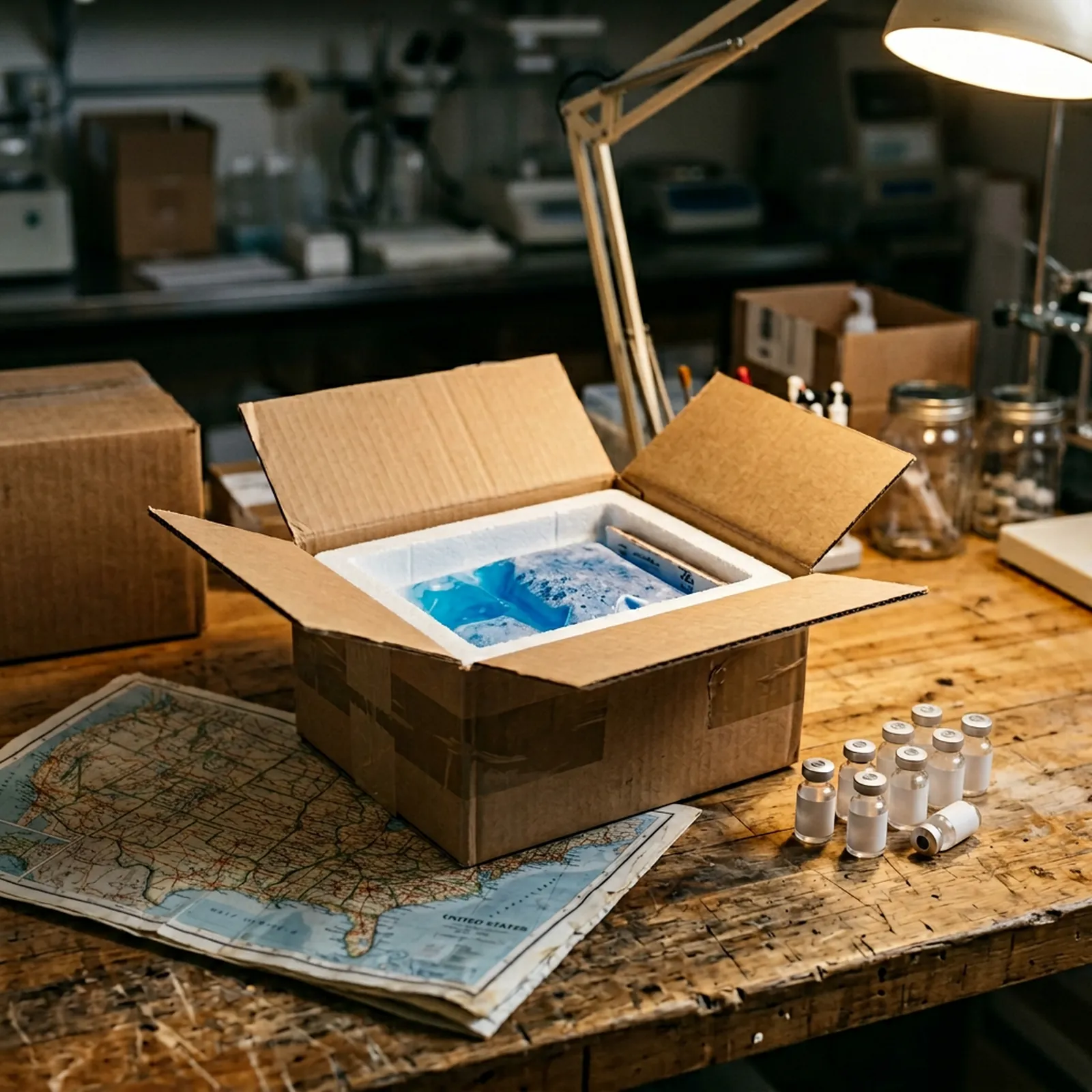
The Question Behind the Search
When a researcher types "peptides near me" into a search engine, they are usually asking a supply-chain question disguised as a geography question. They want a reliable source of research-grade, RUO-labeled peptides — preferably fast, preferably with documentation they can actually use, and ideally without the delays that can stall a preclinical experiment. Location is a proxy for speed and convenience. But for research peptides specifically, geography is often the least useful variable in the sourcing equation.
This article covers how research labs in the ten largest U.S. metro areas actually source RUO peptides — the institutional supply chains they use, the distributors they work with, the direct-to-lab vendors they call on when standard channels fall short, and the shipping logistics that determine whether a peptide arrives in usable condition. It is not a directory of local clinics or compounding pharmacies. It is a practical sourcing guide for bench researchers and procurement staff working in non-clinical, in-laboratory research settings.
New York Metro: Dense Research Infrastructure, Fragmented Sourcing
The New York metropolitan area — spanning New York City, northern New Jersey, and lower Connecticut — hosts one of the highest concentrations of biomedical research institutions in the world. NYU Grossman School of Medicine, Columbia University Irving Medical Center, Weill Cornell Medicine, Memorial Sloan Kettering, Rockefeller University, and dozens of independent biotech firms clustered in Manhattan, the Hudson Yards life sciences corridor, and the New Jersey Biopharma Hub in New Brunswick all maintain active procurement operations for biochemicals including research peptides.
Large institutional labs in this metro typically route peptide purchases through Thermo Fisher Scientific or Sigma-Aldrich (MilliporeSigma) under existing purchasing agreements. For standard research peptides with long catalog histories — oxytocin, angiotensin II, bradykinin — those distributors are adequate. For newer preclinical-stage peptides like BPC-157 (CAS 137525-51-0, a 15-amino acid gastric pentadecapeptide) or TB-500 (thymosin beta-4 fragment, CAS 77591-33-4, 43 amino acids), catalog availability is inconsistent and lead times can run one to three weeks. Smaller labs and independent researchers in this metro frequently supplement institutional distributors with direct-to-lab RUO vendors capable of overnight shipping.
From 22EXO's Pennsylvania fulfillment location, overnight transit to any New York metro zip code is reliable year-round via standard carrier next-day air services. With insulated packaging and gel ice packs rated for 48-hour performance, lyophilized peptide vials arrive at temperature even in summer.
Los Angeles Metro: Biotech Corridors and University Supply Chains
The greater Los Angeles area — including the Westside biotech corridor (Santa Monica, El Segundo), the South Bay (Torrance, Carson), the San Fernando Valley, and the broader San Gabriel Valley — is home to UCLA, USC, Cedars-Sinai Research Institute, City of Hope, and a growing cluster of early-stage biotech companies. The Westside corridor in particular has seen substantial investment in cell and gene therapy platforms, many of which use synthetic peptides as research tools in cell culture and assay development.
University supply chains at UCLA and USC route through the same major distributors as East Coast institutions. The biotech cluster is more likely to use specialized vendors, particularly for research peptides with niche applications. Cross-country shipping from Pennsylvania to the Los Angeles metro adds transit time — a next-day air shipment sent Monday from a Pennsylvania facility arrives in Los Angeles Tuesday under normal conditions, but Friday orders may face a Monday delivery window if a vendor's cold-chain design requires shipping only at the start of the week to avoid weekend delays. Labs in the Los Angeles metro should plan orders with a one-to-two-day buffer to account for cross-country transit logistics.
Chicago Metro: Midwest Research Hub
Chicago's research corridor spans the Illinois Medical District on the Near West Side — home to Rush University Medical Center, UI Health, and Jesse Brown VA Medical Center — along with Northwestern University's Chicago campus, Loyola University Health System, and the Argonne National Laboratory complex to the southwest. The Chicago area also hosts a moderate biotech cluster in the suburbs, particularly around Lake Forest and Deerfield (AbbVie's global headquarters), where research procurement standards are pharmaceutical-grade.
For labs in this metro, the standard supply chain is well-developed. AbbVie and similar large pharma neighbors have established the institutional frameworks for RUO biochemical procurement, and smaller academic labs benefit from the vendor infrastructure built around that demand. Overnight transit from Pennsylvania to Chicago is approximately 12–16 hours via next-day air, making 22EXO's Tuesday-through-Thursday shipping window practical for most research schedules.
Houston Metro: Medical Center Scale
The Texas Medical Center in Houston is the largest medical complex in the world by physical size. MD Anderson Cancer Center, Houston Methodist Research Institute, Baylor College of Medicine, UTHealth Houston, and the University of Houston's research programs collectively represent enormous demand for research biochemicals. Peptide sourcing in this metro tends to be institutionalized — large labs negotiate directly with Thermo Fisher or Sigma-Aldrich procurement teams, sometimes achieving catalog pricing that makes specialized vendors competitive only on lead time and documentation quality rather than unit cost.
For peptides outside standard distributor catalogs, Houston labs are accustomed to ordering from vendors in other states. Texas has no additional state-level restrictions on RUO peptide purchases as of the current regulatory environment. Overnight air freight from Pennsylvania to Houston's George Bush Intercontinental or Hobby Airport areas is standard carrier service, with most packages arriving by 10:30–12:00 PM the following business day.
Phoenix Metro: Growing Research Infrastructure
Phoenix has grown substantially as a research hub over the past decade. The Mayo Clinic's Arizona campus in Scottsdale, the Translational Genomics Research Institute (TGen), Arizona State University's biomedical engineering programs in Tempe, and the University of Arizona College of Medicine Phoenix collectively represent a research community that is smaller than New York or Houston but growing quickly. Biotech startups in the Camelback Corridor and the Hayden Ferry Lakeside complex also maintain active peptide procurement needs.
Phoenix labs share the challenge of Los Angeles-area labs: cross-country transit adds a day compared to East Coast sourcing. A supplier in Pennsylvania can still reach Phoenix by overnight air in most cases, but labs should confirm shipping day cutoffs and carrier service levels before committing to an experiment schedule that depends on Tuesday arrival of a Monday order.
Philadelphia Metro: Proximity Advantage for Northeast Labs
The Philadelphia metropolitan area — including the Route 202 pharmaceutical corridor in Montgomery County, the University City district adjacent to Penn and Drexel, the Children's Hospital of Philadelphia research campus, and the Thomas Jefferson University complex — is itself a significant research market. Labs in this metro are, notably, the closest to 22EXO's shipping facility of any metro on this list. Same-day local pickup is not offered, but for a lab in Philadelphia proper, next-day air effectively functions as a local delivery at overnight pricing.
The Route 202 corridor, home to GSK's North American headquarters in Upper Providence Township and multiple contract research organizations (CROs), has established procurement infrastructure that includes familiarity with RUO labeling requirements and COA documentation standards. Labs in this corridor tend to be sophisticated buyers who ask for lot-specific HPLC data as a matter of course.
Miami Metro: South Florida Research Activity
The University of Miami Miller School of Medicine, Florida International University's Herbert Wertheim College of Medicine, and the Bascom Palmer Eye Institute anchor Miami's biomedical research community. The Brickell and Wynwood areas have also attracted biotech and longevity-focused research companies in recent years, partly driven by the post-2020 migration of venture-backed companies from the coasts. These newer entrants tend to use direct-to-lab RUO vendors rather than institutional distributor agreements because their procurement volumes do not yet justify the negotiating overhead.
Florida has not enacted state-level restrictions on RUO peptide sourcing comparable to Oklahoma's 2023 legislation. Overnight transit from Pennsylvania to Miami runs approximately 14–16 hours by air freight, making same-day-order, next-day-delivery schedules achievable for orders placed before standard cut-off times.
Dallas Metro: UT Southwestern and the Biotech Build-Out
UT Southwestern Medical Center in Dallas is one of the most research-intensive institutions in the Southern United States, with more than $700 million in annual research expenditures and 26 Howard Hughes Medical Institute investigators as of recent reporting. Baylor Scott & White Research Institute, Texas Health Resources, and a growing cluster of biotech companies along the Dallas North Tollway corridor round out the local research ecosystem.
Dallas labs sourcing RUO peptides face the same logistics picture as Houston: no state-level barriers, reliable overnight air freight from Pennsylvania, and a research community comfortable with direct-to-lab purchasing when institutional catalogs fall short. The UT Southwestern supply chain is large enough to have pre-negotiated vendor approval processes, but adding a specialized RUO peptide vendor to the approved list is typically a documentation exercise rather than a substantive barrier.
Atlanta Metro: CDC Adjacency and Academic Research
Atlanta's research community is shaped by two anchors: Emory University (Emory School of Medicine, Yerkes National Primate Research Center) and the Georgia Institute of Technology's bioengineering programs. The proximity of the Centers for Disease Control and Prevention in the Druid Hills area also generates ancillary research activity. Morehouse School of Medicine and the Georgia Cancer Center at Augusta University extend the metro's footprint across the state.
For peptide-focused research — particularly work on tissue remodeling, fibrosis, and extracellular matrix biology — Emory's pharmacology and bioengineering groups have been active users of preclinical peptide tools. Overnight transit from Pennsylvania to Atlanta's Hartsfield-Jackson area is approximately 10–12 hours, among the shorter cross-country transit times on this list.
Seattle Metro: Life Sciences on the Sound
Seattle's life sciences corridor runs from the South Lake Union neighborhood — home to several Amazon-adjacent biotech ventures and the Allen Institute for Brain Science — north through the University of Washington's Health Sciences complex and east to the Eastside communities of Bellevue and Redmond, where biotech infrastructure has grown alongside the technology sector. Fred Hutch Cancer Center, Benaroya Research Institute, and Seattle Children's Research Institute are among the anchor institutions.
Seattle labs sourcing from the East Coast face the longest transit times of any metro on this list. Overnight air from Pennsylvania to Seattle-Tacoma International is achievable on most routes, but labs should build extra lead time into their ordering cadence for time-sensitive experiments. Cold-chain integrity is a higher concern for Seattle orders placed near a holiday or a Thursday/Friday — a delayed delivery that falls over a weekend can compromise a lyophilized peptide shipment even if it would have been fine on a normal Tuesday arrival.
Why "Near Me" Is the Wrong Question for Research Peptides
The logic behind a local sourcing preference is sound in many procurement contexts: a local hardware supplier can provide same-day pickup; a regional chemical distributor might offer will-call for urgent orders. But research peptides do not fit those logistics models for several reasons.
First, the product is not perishable in the way that, say, primary cells or live organisms are. A lyophilized peptide vial in proper cold storage is stable for 24 months or longer. There is no window of viability that requires geographic proximity. Second, the quality of a peptide is defined by its COA documentation — HPLC purity trace, mass spec identity confirmation, endotoxin testing — not by where it was made or where it is stored. A supplier three time zones away who provides a lot-specific COA with ≥98% HPLC purity is a higher-quality source than a local distributor who cannot produce the same documentation. Third, the logistics of overnight shipping from a single, well-managed fulfillment center are often faster and more reliable than sourcing through a regional distributor who may not stock the specific peptide you need and who may not have designed their warehousing for cold-chain integrity.
An overnight air shipment from 22EXO's Pennsylvania facility, placed by 12:00 PM Eastern on a business day, reaches most major metro areas the following morning — typically within 18–24 hours of order placement. A researcher in Houston or Seattle who is looking for a local supplier, driving to a distributor warehouse, and finding the product out of stock or improperly stored, has not saved time. They have lost a day and introduced uncertainty into their experiment.
The right question is not "which supplier is geographically closest?" It is: "which supplier provides the documentation I need, ships with proper cold-chain logistics, and can reliably deliver to my lab within my experiment's timeline?"
What to Look for in a RUO Peptide Supplier
Whether you are in New York, Los Angeles, or any other metro, the evaluation criteria for a RUO peptide supplier are consistent. These are the questions worth asking before placing a first order.
Certificate of Analysis on every lot. Not a generic document that applies to a product line — a lot-specific COA showing HPLC purity percentage, the chromatogram, mass spectrometry identity confirmation with observed versus theoretical molecular weight, and the lot number that matches the vial you receive. 22EXO provides this on every batch for every product.
HPLC purity ≥98%. Purity below this threshold introduces contaminating peptide fragments and deletion sequences that can confound assay results. For cell-based assays or in vivo preclinical studies, impurity profiles matter.
Cold-chain shipping protocol. Insulated packaging with adequate ice pack capacity for the expected transit duration. Summer shipping in particular requires gel packs rated for longer windows than standard foam coolers provide. Ask specifically about the vendor's summer shipping policy.
RUO labeling and terms of sale that reflect actual intended use. A vendor who markets peptides for personal use under a thin RUO disclaimer is not operating correctly, and purchasing from such a vendor creates compliance exposure for your institution. Labeling and sales terms should clearly reflect non-clinical research use.
Endotoxin testing for in vitro work. Lipopolysaccharide (endotoxin) contamination is a significant confounder in cell culture experiments. Endotoxin-tested peptides, or suppliers who can provide LAL assay data on request, are preferable for sensitive cell-based research applications.
Responsive technical and customer support. For researchers who need to understand solubility characteristics, reconstitution conditions for unusual buffer systems, or stability data at non-standard temperatures, the ability to reach a knowledgeable contact at the vendor matters more than geographic proximity.
BPC-157, TB-500, and the BPC-157/TB-500 Blend in Research Supply Context
Three peptides that labs across all of these metros have incorporated into tissue-remodeling and regenerative biology research protocols are BPC-157, TB-500, and combinations of the two.
BPC-157 (body protection compound 157, CAS 137525-51-0) is a 15-amino acid synthetic peptide derived from a segment of the human gastric juice protein BPC. Preclinical literature from the 1990s through the present — much of it from Sikirić et al. at the University of Zagreb — documents effects on angiogenesis, nitric oxide synthesis, and growth factor signaling in rodent injury models. In vitro studies have examined its effects on fibroblast migration (concentrations typically 1–100 ng/mL in published protocols) and endothelial tube formation assays.
TB-500, the synthetic analog of thymosin beta-4 (TB4) comprising the primary bioactive sequence (Ac-SDKPDMAEIEKFDKSKLKKT, 43 amino acids, CAS 77591-33-4), has been investigated for its role in actin monomer sequestration, cell migration, and inflammatory modulation in preclinical models. In vitro concentrations in published thymosin beta-4 studies range from 10 ng/mL to 10 mcg/mL depending on the assay system and endpoint.
The BPC-157/TB-500 blend combines both in a single lyophilized preparation, useful for research protocols examining the interaction of the two pathways or for laboratories running pilot experiments before committing to single-compound studies. All three are available as 5 mg RUO vials from 22EXO with COA documentation on every lot.
Practical Ordering Logistics
For labs in any of the ten metros discussed, the practical ordering workflow is the same. Identify your required quantity (5 mg vials allow reconstitution to standard research concentrations with sufficient volume for most short-term protocols). Place the order before the vendor's daily cut-off time on a Monday through Wednesday to ensure delivery arrives before the end of the week. Confirm that the shipping address is a staffed location that can receive and refrigerate the package on delivery day — a vial sitting in a shipping dock over a long weekend is a cold-chain failure even if transit was perfect. Upon receipt, inspect the vial and confirm the lyophilized cake appearance and stopper integrity before logging the lot number from the COA.
Geography did not determine the quality of that protocol. Logistics, documentation, and supplier standards did.
Frequently Asked Questions
What does 'RUO' mean, and why does it matter when sourcing peptides for a lab?
RUO stands for Research Use Only. It is an FDA-recognized labeling designation, defined under 21 CFR 809.10, indicating that a compound is intended for non-clinical, in-laboratory research and has not been evaluated for safety or efficacy in humans or animals. For a purchasing lab, RUO labeling has several practical implications. First, it means the supplier is not making drug claims, so the product falls outside FDA drug approval pathways. Second, it defines the acceptable scope of use: in vitro studies, preclinical animal research, assay development, and mechanistic investigations. Third, it governs how a legitimate supplier structures its sales, terms of service, and documentation. A lab sourcing peptides for any of those purposes should purchase from a vendor whose products are explicitly labeled RUO, accompanied by a Certificate of Analysis (COA) documenting purity by <a href="/blog/peptide-purity-hplc-testing-guide">HPLC</a> and identity by mass spectrometry. Sourcing from a vendor that does not provide lot-specific COA documentation introduces purity and identity uncertainty that can invalidate experimental results. When comparing vendors across any metro, the COA is the first thing a lab procurement officer should request — and if a vendor cannot provide it, that is sufficient reason to look elsewhere.
Can research peptides be sourced through a university supply chain?
University supply chains are typically built around procurement agreements with large laboratory distributors — Thermo Fisher Scientific, Sigma-Aldrich (MilliporeSigma), VWR, and Fisher Scientific being the most common. These distributors stock a wide range of biochemicals, but their peptide catalogs tend toward well-established research standards: angiotensin II (CAS 68521-88-0), bradykinin, <a href="/product/oxytocin-5mg">oxytocin</a>, and similar compounds with long track records in academic pharmacology. Newer, preclinical-stage peptides like <a href="/product/bpc-157-5mg">BPC-157</a> (CAS 137525-51-0) or TB-500 (thymosin beta-4 fragment, CAS 77591-33-4) may not appear in standard distributor catalogs, or may be listed at catalog prices substantially higher than direct-to-lab RUO vendors. Many university researchers who work specifically with tissue-repair or regenerative biology peptides supplement their standard supply chain with direct procurement from specialized RUO vendors, routing purchases through their institution's standard purchase order system. Whether a university's purchasing department will process such an order depends on the institution's supplier vetting process, but the documentation a quality RUO vendor provides — COA, HPLC data, synthesis certificates — typically satisfies institutional requirements.
How should lyophilized peptides be shipped to ensure they arrive in usable condition?
Lyophilized (freeze-dried) peptides in sealed, nitrogen-flushed vials are considerably more stable during shipping than reconstituted solutions, but they are not unconditionally stable. The primary risks during transit are heat exposure and physical shock. High temperatures — particularly above 25–30°C during summer months or in vehicles without climate control — can accelerate the oxidation of susceptible residues (methionine, cysteine, tryptophan) and promote Maillard-type reactions that discolor and degrade the peptide. Physical shock can fracture the lyophilized cake, which does not directly degrade the peptide but can make volume-accurate <a href="/blog/peptide-reconstitution-handling-guide">reconstitution</a> more difficult. Best-practice shipping for research peptides uses insulated packaging with gel ice packs designed for 24–48 hour performance, shipping overnight or two-day on business days only to avoid weekend delays. A supplier shipping from a single facility — such as 22EXO's Pennsylvania fulfillment center — can build these logistics consistently into every order, whereas a lab attempting to source locally from a regional distributor may encounter inconsistent cold-chain handling if that distributor was not designed specifically for peptide shipment.
What is the difference between a lab supply distributor and a direct-to-lab RUO vendor for peptides?
Large laboratory distributors (Thermo Fisher, Sigma-Aldrich, VWR) operate as intermediaries: they purchase compounds from manufacturers, warehouse them in large regional distribution centers, and sell them through institutional procurement agreements at volume pricing. Their strengths are breadth of catalog, institutional billing relationships, and compliance documentation formats that map onto standard university purchasing workflows. Their limitations for specialized peptides include limited catalog depth for newer or niche research compounds, longer lead times for non-stocked items, and less direct quality transparency — you may not easily get lot-specific <a href="/blog/peptide-purity-hplc-testing-guide">HPLC</a> chromatograms for every item. Direct-to-lab RUO vendors specialize in a narrower product range, typically with greater depth of quality documentation per SKU. A vendor like 22EXO provides COA documentation on every batch, with HPLC purity ≥98% verification and mass spectrometry identity confirmation. The tradeoff is that a specialized vendor may not be pre-approved in your institution's purchasing system, but the approval process is generally straightforward once the vendor can supply the documentation a compliance office requires.
Are there any metro-specific regulations that affect research peptide purchasing in the U.S.?
The federal regulatory framework — FDA's RUO labeling rules under 21 CFR 809.10, the Controlled Substances Act administered by the DEA, and the Drug Quality and Security Act — applies uniformly across all U.S. states and metros. However, state-level regulation can create additional layers. Oklahoma enacted legislation in 2023 specifically targeting certain research peptides. Several other states have consumer protection frameworks that could be triggered by marketing language that implies human health benefits. The practical implication for a lab is not that sourcing is restricted in most metros, but that vendors operating in those states may adjust their shipping policies or sales terms. A lab in, for example, Texas (Houston, Dallas) or Florida (Miami) operates under federal rules without meaningful state-level additions for most RUO peptides as of the time of publication. Labs should independently verify current state law for any specific compound rather than relying on general summaries, as the regulatory environment in this area moves quickly.