Biohacking and Peptide Research: How the Consumer Science Community Is Driving Discovery
The biohacker and citizen science community isn't waiting for clinical trials. Here's how consumer demand is reshaping peptide research priorities — and why quality sourcing matters more than most people in this space realize.
Something Unusual Is Happening
The standard model of biomedical discovery runs in one direction: laboratory research produces findings, clinical trials test them, regulatory agencies evaluate the data, and approved therapies reach patients years or decades later. It's slow, expensive, and conservative by design — because the stakes of getting it wrong are high when you're talking about population-level interventions.
Peptide research doesn't fit this model cleanly. And the reason it doesn't has a lot to do with a community that mostly operates outside of formal scientific institutions — the biohacker and citizen science movement.
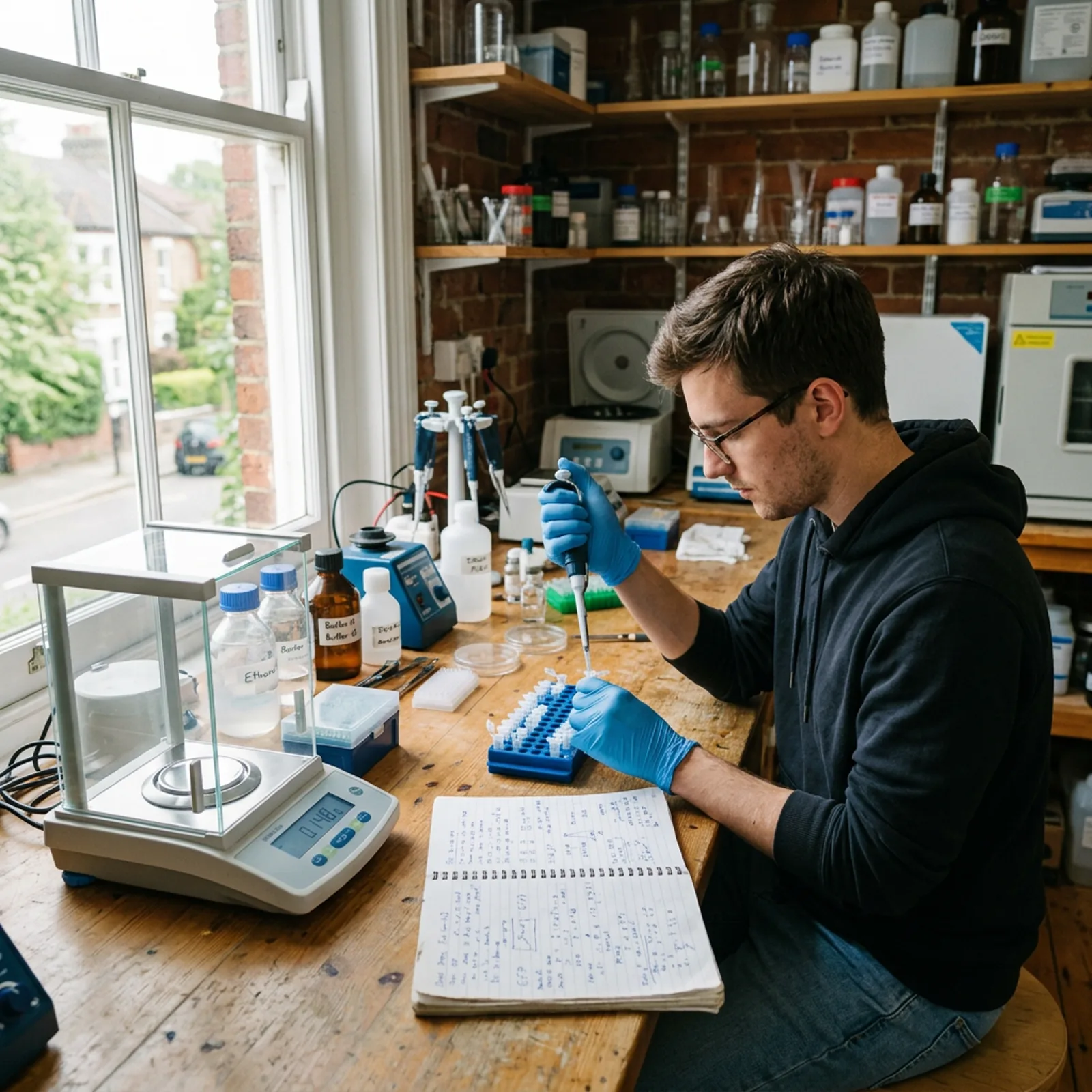
Over the past decade, a substantial population of technically sophisticated, research-literate individuals has been self-experimenting with peptides — reading primary literature, synthesizing findings across studies, sharing protocols, and generating observational data at a scale that academic research budgets can't match. This is worth understanding, not just as a cultural phenomenon, but as an epistemological one: the community is changing what gets studied, what gets attention, and how quickly.
Who Is Actually In This Space
The "biohacker" label is imprecise. The community spans a genuinely wide range. At one end: people who read popular science podcasts and take evidence-based supplements. At the other: researchers, physicians, athletes, and technology workers who have deep working familiarity with pharmacokinetics, receptor pharmacology, and study design — and who are frustrated by the gap between what the preclinical literature suggests is possible and what's available through conventional medicine.
The Silicon Valley connection is real. In January 2026, reporting documented that imports of hormone and peptide compounds from China roughly doubled to $328 million in the first three quarters of 2025, from $164 million in the same period the prior year. Some of that demand comes from tech industry workers who have made peptide self-experimentation part of a broader optimization culture. BPC-157 for injury recovery, Epitalon for sleep and longevity, and various secretagogues for body composition all circulate in these communities with a level of sophistication that sometimes exceeds what's discussed in peer-reviewed review articles.
Reddit communities like r/Peptides and r/Biohackers have become de facto aggregators of self-experimentation data. Someone runs a 12-week protocol, tracks blood markers and subjective outcomes, and posts their results. Dozens of replies add context, raise confounders, suggest modifications. Over thousands of posts, patterns emerge — not in the rigorous sense of controlled trial data, but in the softer sense of observational signal. What consistently gets reported as effective? What shows inconsistent results? What produces unexpected side effects?
Podcasters like Andrew Huberman have brought peptide topics to millions of listeners — explaining circadian biology, growth hormone secretion, tissue repair mechanisms — with a level of scientific rigor unusual for mass media. Whether or not you agree with every recommendation, the effect has been a substantial increase in scientifically literate consumer interest in the underlying biology.
The Acceleration Effect
Academic drug development timelines are measured in years to decades. The community moves faster — sometimes recklessly, sometimes productively.
The productive version looks like this: researchers notice that a compound studied for one purpose in animals shows effects on other systems. They start applying it in a related context. The community generates observational data at scale. Some of that data gets written up and published, creating formal citations. Other researchers take notice. Peer-reviewed work starts following community interest rather than leading it.
BPC-157 is a decent example. The peptide has been studied since the 1990s in Yugoslav and Croatian research groups for gastrointestinal applications. The early human clinical trial work was for inflammatory bowel disease. The biohacker community became intensely interested in its musculoskeletal effects around 2015–2018 — well before there was substantial peer-reviewed musculoskeletal literature. By the mid-2020s, a 2025 review in an orthopedic journal was cataloguing 36 studies specifically on BPC-157 in musculoskeletal applications, published from 1993–2024. The acceleration of research attention is partially traceable to consumer demand.
The concerning version looks like this: a compound that is promising in rats gets adopted widely by humans before safety characterization is adequate. The 2025 orthopedic review noted explicitly that for BPC-157 in humans, there is "no clinical safety data" beyond case series. That doesn't mean it's dangerous — it means the risk profile in humans isn't formally characterized. The community often treats "no reported problems in self-experimentation forums" as proxy for safety data. It isn't.
The Supply Chain Problem
Cohen et al., writing in JAMA Internal Medicine in 2021, analyzed the composition of dietary supplements and research compounds being sold online in a context documenting the broad problem of label accuracy and purity in the supplement and research compound space. The findings underscored something the biohacker community knows but underweights: a significant fraction of products sold for research purposes contain something different from what's on the label — wrong concentration, impure compound, degraded peptide, or in some cases wrong molecule entirely.
This is not a minor problem for research integrity. If community members are self-experimenting with impure or mislabeled compounds, the observational data they generate is confounded at the source. Someone reports that a 12-week BPC-157 protocol produced dramatic healing effects — but if the compound they used was actually 60% purity and contained unknown impurities, what are they reporting on? This is why quality verification — specifically HPLC testing and third-party certificates of analysis — is the baseline minimum for research-grade peptide supply.
It's also why the sourcing question matters more in peptide research than in many other areas. Amino acid composition can be verified. Purity can be tested. Sequence fidelity can be confirmed. These are not marketing claims — they're analytical results that should be available to researchers before they use any compound.
Where 22EXO Stands In This
22EXO exists at the intersection of consumer research interest and scientific rigor. We're not a pharmaceutical company with clinical trials. We're not a gray-market operation. We're a research supply company — which means our obligation is to the research community: accurate labeling, verified purity, and honest framing about what the evidence does and doesn't support.
That framing matters. We don't claim our peptides treat diseases or extend lifespan. We do claim that the compounds we sell — including BPC-157, Epithalon, Semax, and MOTS-c — are research-grade, third-party tested, and accurately labeled. Those are claims we can verify and stand behind.
We also think the biohacker community is doing something genuinely interesting and scientifically valuable — not as a replacement for controlled clinical research, but as a parallel information stream that's generating hypotheses at a pace academic funding cycles can't match. The research community and the self-experimenter community benefit from honest exchange rather than mutual dismissal.
The Tension Is Actually Productive
The gap between what the community wants to know and what the clinical literature has established creates friction. But friction can be generative. Questions the community is asking — does BPC-157 actually accelerate tendon healing in humans? What's the optimal timing for GH secretagogues relative to sleep? Does Epithalon's telomerase effect in cell culture translate to any functional benefit in aging humans? — are the same questions academic labs are increasingly being funded to answer.
The dynamic is accelerating. Sarmiento-Salinas et al., writing in Nature Reviews Drug Discovery in 2020, noted the expanding role of AI-assisted discovery in peptide drug development, with the field growing rapidly as computational tools make identifying promising candidate compounds faster and cheaper. Peptides that would have taken years to identify and synthesize a decade ago can now be designed computationally and tested within months. Consumer interest is one reason investment in this area is rising.
The community has not replaced academic science. But it has changed the questions academic science is being asked to answer — and the pace at which it answers them. That's a real contribution, even if it comes packaged in forums and podcasts rather than journals.
The Epistemology of N=1 Research
There's a concept in the biohacker community called "N=1" — meaning single-subject self-experimentation. You're the one research subject. You test something on yourself, measure what you can, and report the results. It's intellectually honest about what it is: a case study, not a controlled trial. It can be informative. It is not generalizable.
The community's relationship with N=1 data is complicated. At best, it generates hypotheses that can be tested more rigorously. Someone notices that a 12-week BPC-157 protocol coincides with faster resolution of a chronic tendon issue, blood CRP drops, and subjective energy improves. That's not evidence BPC-157 caused those changes — it's an observation that raises a question worth investigating with proper controls. At worst, N=1 observations get reported as if they're generalizable findings, confirmatory bias fills in the interpretation, and the community collectively mistakes accumulated anecdotes for data.
The more sophisticated community members are actually fairly good at flagging these limitations. On r/Peptides, you'll regularly see posts that caveat findings with "n=1, YMMV" (your mileage may vary), acknowledge confounders, or note where blinding would have been needed to rule out placebo effects. The signal-to-noise ratio is imperfect but better than critics often give credit for.
What makes this interesting scientifically: at sufficient scale, even methodologically imperfect self-reports can identify signals that wouldn't surface otherwise. If 500 people report a consistent side effect that hasn't been documented in animal models, that's worth investigating. If a compound consistently fails to produce its purported effects across diverse self-experimenter reports while animal studies predict it should work, that gap is itself a finding — possibly about species translation, bioavailability, or dosing assumptions.
Quality as an Ethical Obligation
The supply quality problem in the peptide research space isn't just a research integrity issue — it's an ethical one. People who are self-experimenting with peptides are making decisions about what to put in their bodies based on what they believe a compound is. If that compound is mislabeled, impure, or degraded, those decisions are uninformed in a way the person can't compensate for with research knowledge.
The research community — including companies in this space — has an obligation to close this gap. Third-party HPLC testing with published results is the minimum. Lot-specific certificates of analysis that buyers can verify independently is the standard 22EXO holds itself to. When we supply BPC-157, Epithalon, Semax, or MOTS-c, the purity and sequence fidelity of those compounds are not claims we make without verification. That isn't a marketing posture. It's what research supply should mean.
The broader industry hasn't uniformly adopted this standard. Some suppliers operate with minimal quality control and maximum marketing claims. Others sell compounds of legitimate research quality. The difference matters — not just for data integrity, but for the people using these compounds. Informed research requires accurate starting material. That's true whether the research is happening in a university lab or in someone's home.
For foundational context on peptide research, see our Peptides 101 guide. Our piece on HPLC testing and purity verification covers the quality question in detail. And if you're reconstituting peptides for the first time, our reconstitution and handling guide covers everything you need to know.
Frequently Asked Questions
What is the biohacker community's relationship with peptide research?
Biohackers are technically sophisticated self-experimenters who read primary research literature and share observational data at scale through forums, podcasts, and online communities. They've accelerated attention to peptide compounds (like <a href="/product/bpc-157-5mg">BPC-157</a> for musculoskeletal healing) well before peer-reviewed clinical research caught up — generating real-world signal that has influenced academic research priorities.
Is self-experimenting with peptides safe?
This is genuinely hard to answer because safety data in humans for most research peptides is limited. 'No reported problems in forums' is not the same as clinical safety data. The 2025 orthopedic review of <a href="/product/bpc-157-5mg">BPC-157</a> noted explicitly that there is no formal clinical safety characterization in humans beyond small case series. Self-experimentation involves meaningful unknown risk and should not be undertaken casually.
Why does peptide purity matter so much?
If you're self-experimenting with or researching a peptide that turns out to be impure or mislabeled, any observations you make are confounded from the start. Cohen et al. (JAMA Internal Med, 2021) documented widespread label accuracy problems in the supplement and research compound space. <a href="/blog/peptide-purity-hplc-testing-guide">HPLC</a> testing and third-party certificates of analysis are the minimum standard for trustworthy research supply.
How has the biohacker community influenced formal science?
Consumer demand drives research funding and attention. <a href="/product/bpc-157-5mg">BPC-157</a>'s musculoskeletal literature grew substantially after the biohacker community began widely discussing and using it for injury recovery. Academic labs started investigating questions the community had already been asking for years. Sarmiento-Salinas et al. (Nat Rev Drug Discov, 2020) noted the rapid expansion of peptide drug discovery — driven partly by growing market interest that includes consumer experimentation.
Why should I care about where my research peptides come from?
Peptide potency, purity, sequence fidelity, and stability all vary enormously across suppliers. Low-quality suppliers may sell peptides at incorrect concentrations, with impurities from synthesis, or that have degraded due to poor storage. For research to be reproducible — whether you're a formal researcher or an informed self-experimenter — the starting material needs to be what it claims to be. 22EXO uses third-party <a href="/blog/peptide-purity-hplc-testing-guide">HPLC</a> testing to verify purity and provides certificates of analysis.