How to Source GHRP-6: Purity, COA, HPLC, and Red Flags
Sourcing research-grade GHRP-6 means reading a batch-specific COA, an HPLC purity trace, an MS identity result, and the cold chain. A procurement guide.
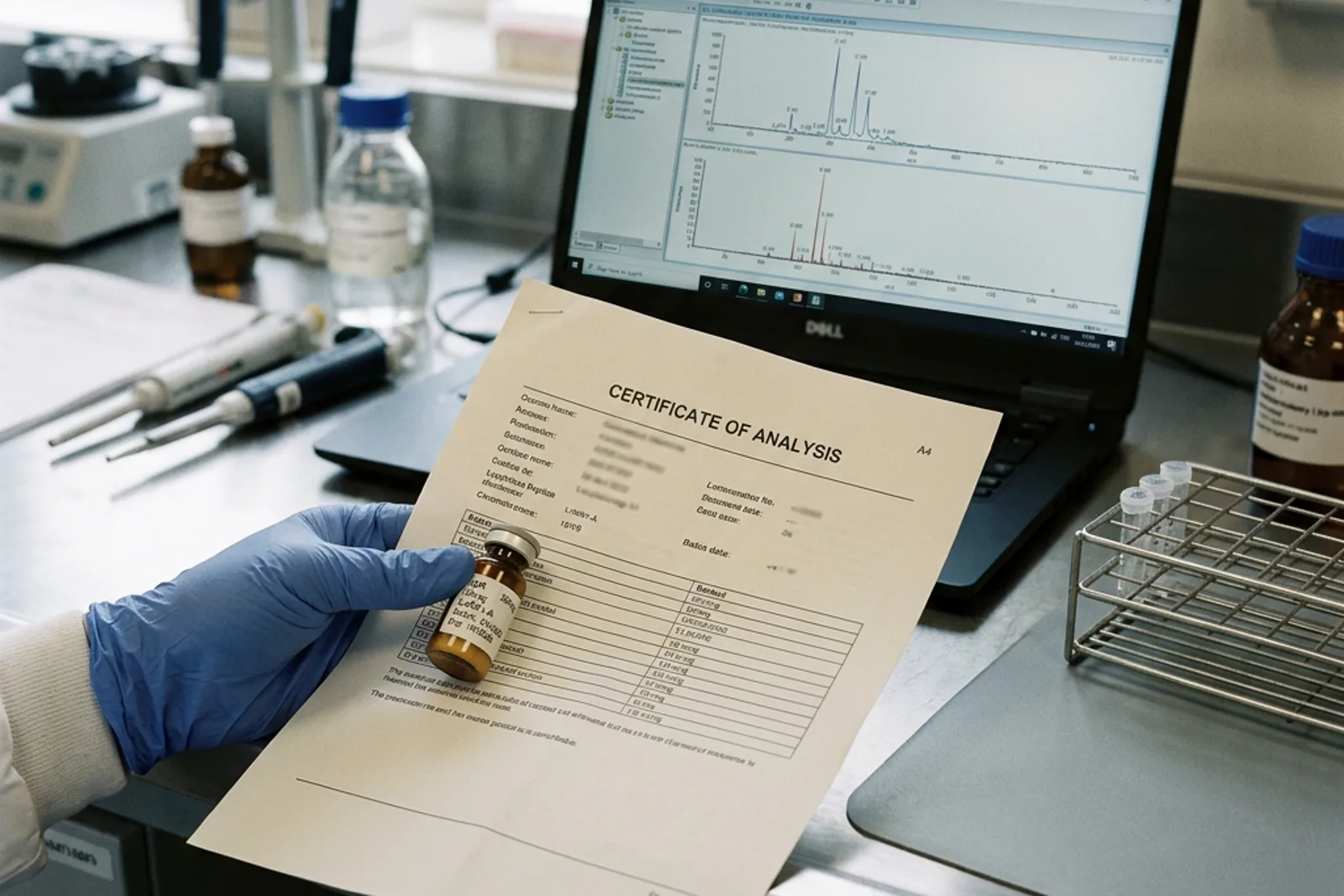
Sourcing research-grade GHRP-6 comes down to three documents and one cold chain: a batch-specific certificate of analysis, an HPLC chromatogram showing the purity number, a mass-spectrometry result confirming the molecule is actually GHRP-6, and proof the lyophilized peptide was kept cold from synthesis to your bench. Everything else a vendor tells you is marketing. This guide walks through what each of those means, how to read them, and the failure modes that separate assay-grade hexapeptide from repackaged powder.
GHRP-6 is a six-residue peptide — His-D-Trp-Ala-Trp-D-Phe-Lys — and a growth hormone secretagogue receptor (GHS-R1a) agonist. For the receptor pharmacology and second-messenger pathway, see our GHRP-6 mechanism overview. This piece is the procurement companion: not what GHRP-6 does, but how to verify the vial in front of you is what the label claims. None of what follows is dosing or use guidance — it is quality-control reading for laboratory procurement.
Start with the certificate of analysis
A certificate of analysis is the single document that ties a physical vial to its test data. The word that matters is batch-specific. A generic COA that lists the same numbers for every order is a specification sheet wearing a COA's clothes — it tells you what the product is supposed to be, not what this lot tested at.
A real COA for GHRP-6 names the lot number, the manufacture or test date, the purity figure with the method that produced it, the identity-confirmation method, and the analyst or lab. The lot number on the paper should match the lot number on the vial. If it doesn't, the document is describing a different batch and tells you nothing about what you received. Quality-focused suppliers publish the COA per lot rather than a single static PDF; that publishing practice is itself a signal worth weighting.
Two numbers anchor the COA, and they answer different questions. Purity asks: what fraction of the material is the intended peptide? Identity asks: is the main component actually GHRP-6? A sample can be 99% pure and still be the wrong molecule — high-purity material of something that isn't your target. You need both questions answered, by two different methods.
HPLC: the purity number
High-performance liquid chromatography is how purity gets quantified. A reverse-phase column separates the target peptide from synthesis byproducts — truncated sequences, deletion peptides, residual protecting groups — and the detector traces a chromatogram. Peak integration divides the main peak's area by the total area of all peaks. That ratio is the purity percentage.
For research-grade peptide, ≥98% by HPLC is the working floor, and many quality programs report ≥99%. The chromatogram itself matters as much as the number printed beside it. One tall, sharp, symmetrical main peak with a flat baseline is what clean material looks like. A cluster of smaller peaks crowding the main one means impurities the integration may or may not have fully captured. When a vendor will show you the actual trace — not just assert a figure — you can read the separation yourself.
This is also where purity quietly drives reproducibility. GHRP-6 is a receptor agonist, and receptor work punishes impure ligand: contaminating sequences shift dose-response curves and make calcium-flux or PI-turnover assays hard to replicate. The same logic applies across the GH secretagogue class, which is why the sourcing standard for CJC-1295 (No-DAC / Mod GRF 1-29) and related compounds is identical. The general principles of reading an HPLC trace are covered in depth in our peptide purity and HPLC testing guide.
Mass spectrometry: the identity check
HPLC tells you the main peak is dominant. It does not tell you what that peak is. Mass spectrometry does. MS measures the molecular mass of the component and compares it against the calculated mass of GHRP-6 (the acetate salt's peptide mass is a known value). When the measured mass matches, you have confirmation that the molecule occupying that clean HPLC peak is the peptide you ordered.
This orthogonal pairing — HPLC for purity, MS for identity — is the canonical research-grade verification standard. The methods answer independent questions, and that independence is the point: a result confirmed by two methods that fail in different ways is far harder to fake or to get wrong by accident. The principle is well established in proteomic peptide identification, where automated MS identifications are routinely subjected to verification steps before they're trusted (verification of automated peptide identifications, PMC2819013).
A COA that says "MS confirmed" without a value is weaker than one reporting the observed mass against the theoretical. Specificity is the tell. Vendors running real orthogonal verification tend to show the number, because they have it.
Cold chain, reconstitution, and stability
A perfect COA describes the peptide at the moment it was tested. What arrives at your bench depends on everything that happened in between. Lyophilized GHRP-6 is comparatively stable as a dry powder kept cold and dark, which is why reputable suppliers ship cold-chain and store at freezer temperatures. Heat and light are the enemies; a peptide that spent a week on a warm loading dock is not the peptide on the certificate.
The stability picture changes the moment the powder is reconstituted. In solution, hexapeptides degrade far faster than as lyophilizate, which is why reconstituted material is kept refrigerated and used within a defined window rather than stored indefinitely. The mechanics of doing this without introducing error — bacteriostatic water, gentle reconstitution, aliquoting to avoid freeze-thaw cycles — are bench technique, and we cover them in the peptide reconstitution and handling guide. For the GH secretagogue family as a whole, the broader sourcing-and-comparison context lives in the growth hormone secretagogues guide.
22EXO ships GHRP-6 (5mg) cold-chain with a batch-specific COA precisely because the document and the cold chain are inseparable — one without the other doesn't get you reproducible material.
Why characterization matters for a receptor agonist
It helps to remember what GHRP-6 was historically: the probe that mapped a receptor before the receptor's natural ligand was known. The growth hormone secretagogue receptor was cloned in 1996 (Howard et al., 1996, Science), and its endogenous agonist, ghrelin, was not identified until 1999 (Kojima et al., 1999, Nature). The synthetic peptides came first and did the mapping. That history is the reason characterization is non-negotiable: the entire value of GHRP-6 as a research tool rests on it being exactly the molecule the literature describes, at a purity that lets receptor assays behave.
Concretely, the studies that defined GHRP-6's pharmacology were run on well-characterized peptide. The demonstration that it stimulates GH release through the phosphatidylinositol/PKC pathway rather than the cAMP route (Lania et al., 1995) depended on clean ligand producing a clean dose-response. Reproducing that kind of result starts at procurement. If the material you bench is a mixture of the target and truncated byproducts, the curve you measure is a property of the mixture, not of GHRP-6 — and the data won't replicate against the published record.
This is the throughline connecting the COA, the HPLC trace, and the MS result back to the science. They are not bureaucratic boxes. They are the conditions under which a receptor experiment means anything. A supplier that treats them as paperwork is telling you something about the material.
Red flags when evaluating a supplier
Some signals reliably separate quality programs from the rest. No COA at all, or a COA you have to email and beg for, is the first. A COA with no lot number, or a lot number that doesn't match the vial, is the second. A purity claim with no method named — "99% pure" with no HPLC trace and no MS — is a claim, not data. "MS confirmed" with no observed mass is thinner than it looks. And a single static PDF reused across every batch means the supplier isn't testing per lot, whatever the header says.
None of these tells you a product is bad. They tell you it's unverified, which for receptor research is the same problem: you can't build reproducible data on a ligand you can't characterize. The discipline that applies to GHRP-6 applies identically to BPC-157 (5mg) and every other research peptide — the molecule changes, the verification standard doesn't.
Frequently asked sourcing questions
What purity should a GHRP-6 COA show?
For research-grade material, ≥98% by HPLC is the working floor, with many quality programs reporting ≥99%. The figure should be accompanied by the actual chromatogram showing a single dominant, symmetrical peak — not just a printed number.
Why does a COA need both HPLC and mass spectrometry?
They answer different questions. HPLC quantifies purity (what fraction is the main peak); MS confirms identity (whether that peak is actually GHRP-6). A sample can be high-purity and still be the wrong molecule, so both methods are applied per batch as an orthogonal pair.
What makes a certificate of analysis "batch-specific"?
It carries a lot number that matches the vial, a test or manufacture date, and test results generated for that specific lot rather than reused boilerplate. If the same PDF accompanies every order, it's a specification sheet, not a per-lot COA.
How should lyophilized GHRP-6 be stored and shipped?
As a dry powder kept cold and dark — reputable suppliers ship cold-chain and store at freezer temperatures. Once reconstituted, hexapeptides degrade faster and are kept refrigerated and used within a defined window rather than stored long-term.
Does GHRP-6 purity actually affect research results?
Yes. GHRP-6 is a GHS-R1a agonist, and receptor assays are sensitive to contaminating sequences that shift dose-response curves. Impure ligand undermines reproducibility, which is why characterization to a documented purity and identity standard is treated as a prerequisite rather than a nicety.
All compounds discussed are for in-vitro research and laboratory use only. Not intended for human or animal consumption. Always consult published literature and institutional guidelines before designing research protocols.
Frequently Asked Questions
What purity should a GHRP-6 COA show?
For research-grade material, at least 98% by <a href="/blog/peptide-purity-hplc-testing-guide">HPLC</a> is the working floor, with many quality programs reporting 99%. The figure should be accompanied by the actual chromatogram showing a single dominant, symmetrical peak.
Why does a COA need both HPLC and mass spectrometry?
They answer different questions. <a href="/blog/peptide-purity-hplc-testing-guide">HPLC</a> quantifies purity (what fraction is the main peak); MS confirms identity (whether that peak is actually <a href="/product/ghrp-6-5mg">GHRP-6</a>). A sample can be high-purity yet be the wrong molecule, so both are applied per batch.
What makes a certificate of analysis batch-specific?
It carries a lot number matching the vial, a test or manufacture date, and results generated for that specific lot rather than reused boilerplate. The same PDF on every order is a spec sheet, not a per-lot COA.
How should lyophilized GHRP-6 be stored and shipped?
As a dry powder kept cold and dark, shipped cold-chain and stored at freezer temperatures. Once reconstituted, hexapeptides degrade faster and are kept refrigerated and used within a defined window.
Does GHRP-6 purity actually affect research results?
Yes. As a GHS-R1a agonist, <a href="/product/ghrp-6-5mg">GHRP-6</a> is studied in receptor assays sensitive to contaminating sequences that shift dose-response curves, so documented purity and identity are treated as prerequisites for reproducibility.