GHRP-6 Research Overview: Mechanism, GHS-R Pathway, and What Studies Show
GHRP-6 is a synthetic hexapeptide and GHS-R1a agonist. A research overview of its receptor pharmacology, the PI/PKC pathway, and the preclinical record.
GHRP-6 is a synthetic hexapeptide — His-D-Trp-Ala-Trp-D-Phe-Lys — that binds the growth hormone secretagogue receptor (GHS-R1a) and, in published laboratory and animal models, triggers a pulse of growth hormone release from pituitary somatotrophs. That is the short answer researchers come looking for. The longer answer, the one that explains why a peptide first described in the 1980s still anchors a whole class of GH secretagogue research, lives in the receptor it activates and the second-messenger cascade that follows.
This overview covers what the peer-reviewed record actually shows about GHRP-6: its receptor pharmacology, the intracellular pathway it switches on, how it differs from the GHRH and ghrelin systems it overlaps with, and the preclinical cytoprotection findings that pushed the molecule beyond a simple "GH-releaser" label. Everything here is framed for in-vitro and animal research. No human protocol is described or implied.
What GHRP-6 is, in receptor terms
GHRP-6 belongs to the growth hormone-releasing peptides (GHRPs), a family of small synthetic peptides identified through the work of Cyril Bowers and colleagues beginning in the 1980s, before the body's own ligand for their target was even known. The peptides came first; the receptor and its natural ligand came later. That sequence matters, because it means GHRP-6 was the probe that helped map a signaling system, not a molecule designed to fit one.
The target is the growth hormone secretagogue receptor, GHS-R1a — a G-protein-coupled receptor cloned by Howard and colleagues in 1996 (Howard et al., 1996, Science). For three years it sat as an "orphan" receptor with a known synthetic activator but no identified endogenous ligand. Then ghrelin, the gut-derived peptide, was isolated by Kojima and colleagues in 1999 and shown to be the natural agonist (Kojima et al., 1999, Nature). GHRP-6 and ghrelin act on the same receptor, which is why the two are constantly cross-referenced in the literature.
So when researchers ask what GHRP-6 "is," the precise framing is: a GHS-R1a agonist that predates the discovery of the receptor's endogenous ligand. For laboratories sourcing the compound, that pharmacological identity — and the purity that lets you actually study it — is the whole game. 22EXO publishes a certificate of analysis on every batch of GHRP-6 (5mg) for exactly this reason; receptor work is only as clean as the ligand you start with.
The mechanism: PI turnover, PKC, and calcium
Here is where GHRP-6 gets interesting, and where it parts ways with growth hormone-releasing hormone. GHRH works largely through the cAMP/PKA axis. GHRP-6 does not. Work on cultured human pituitary somatotroph cells demonstrated that GHRP-6 drives growth hormone secretion through the phosphatidylinositol (PI) second-messenger system — activating protein kinase C and mobilizing intracellular calcium — and that the effect is cAMP-independent (Lania et al., 1995).
In that study, incubating somatotroph cells with GHRP-6 produced a dose-dependent rise in the rate of PI turnover. The effect was measurable after 15 minutes and peaked around two hours. PI turnover increased in eight of eight tumor samples examined, with increases ranging from roughly 2.1- to 7.9-fold, and growth hormone secretion rose in parallel. The stimulation occurred whether or not gsp oncogenes were present, underscoring the cAMP-independent character of the response.
The practical takeaway for mechanism-focused work: GHRP-6 and GHRH push the same output — GH release — through different doors. When the two are studied together in animal models, the combined GH response is larger than either alone, which is the synergy that made GHRP-6 a standard comparator in secretagogue pharmacology. Researchers studying the parallel GHRH-analog axis often cross-reference CJC-1295 (No-DAC / Mod GRF 1-29) for precisely this reason.
The GHS-R system and where ghrelin fits
The receptor GHRP-6 activates is expressed in the pituitary and hypothalamus, but also more widely — a distribution that hinted early on that the system did more than regulate GH. Reviews of the GHS-R literature trace how the receptor's expression pattern and signaling reach into appetite regulation, energy balance, and cardiovascular tissue (Smith et al., 2009, in the growth hormone secretagogue receptor literature).
Functional GHS-R expression shows up early in development, too. Studies of human fetal pituitary tissue found that it expresses a functional growth hormone-releasing peptide receptor responsive to GHRP-6 (Shimon et al., 1998), reinforcing that this is a conserved signaling node rather than a pharmacological curiosity.
Ghrelin's identification as the endogenous agonist reframed everything. It meant GHRP-6 had been, all along, a synthetic mimic of a real hormonal system. The appetite-stimulating side of GHS-R1a signaling — well documented for ghrelin — is the reason GHRP-6 is frequently described in the research record as producing a hunger response in animal models, a point researchers note when separating GHRP-6 from more selective later-generation secretagogues.
Where GHRP-6 sits among the secretagogues
GHRP-6 was first. That single fact shapes how it reads in the modern literature. The peptides that followed — GHRP-2, hexarelin, and the non-peptide ghrelin mimetics — were, in large part, attempts to refine what GHRP-6 demonstrated: that you could provoke a GH pulse through a receptor distinct from the GHRH receptor. Each later compound traded something. Some chased greater potency at the same receptor. Others aimed for oral bioavailability or a cleaner separation of GH release from the appetite signaling that GHS-R1a activation carries.
This is why GHRP-6 endures as a reference point rather than a relic. In comparative pharmacology, it is the baseline against which newer secretagogues are measured. A study reporting that a compound is "more selective than GHRP-6" or "produces a GH response comparable to GHRP-6" is using the hexapeptide as the calibration standard. For a research program mapping the GHS-R system, starting with the original probe — well-characterized and at known purity — keeps later comparisons interpretable.
The appetite dimension is the clearest example of this trade-off in the record. Because GHRP-6 is a relatively non-selective GHS-R1a agonist, animal studies consistently note a feeding response alongside GH release. Later secretagogues were designed in part to attenuate that. Researchers who specifically want to study the coupled GH-and-appetite signaling — rather than set appetite aside as noise — often return to GHRP-6 precisely because it does not separate the two.
Beyond GH: the cytoprotection research
A second research thread looks at GHRP-6 outside the pituitary entirely. Because GHS-R and the related scavenger receptor CD36 are present in cardiac and other tissues, several preclinical groups have examined whether GHRP-6 has direct tissue-protective effects independent of growth hormone. The body of work on cardiac and extracardiac cytoprotection describes GHRPs binding these receptors and engaging downstream survival signaling in animal and in-vitro injury models.
This is preclinical work, and it should be read that way. The findings describe cellular and tissue responses in controlled models — not outcomes in people. But they explain why GHRP-6 remains a molecule of interest beyond endocrinology labs: it appears to engage receptors in tissues far from the pituitary, and the survival-signaling angle is an active research question rather than a settled one. Researchers comparing recovery-oriented peptide mechanisms often study GHRP-6 alongside compounds like BPC-157 (5mg), though the receptor systems involved are distinct.
What clean GHRP-6 research requires
Receptor pharmacology punishes impure ligand. A GHS-R agonist contaminated with truncated sequences or counter-ions skews dose-response curves and makes calcium-flux or PI-turnover assays unreproducible. The literature above was built on well-characterized peptide; replicating it means starting from the same standard.
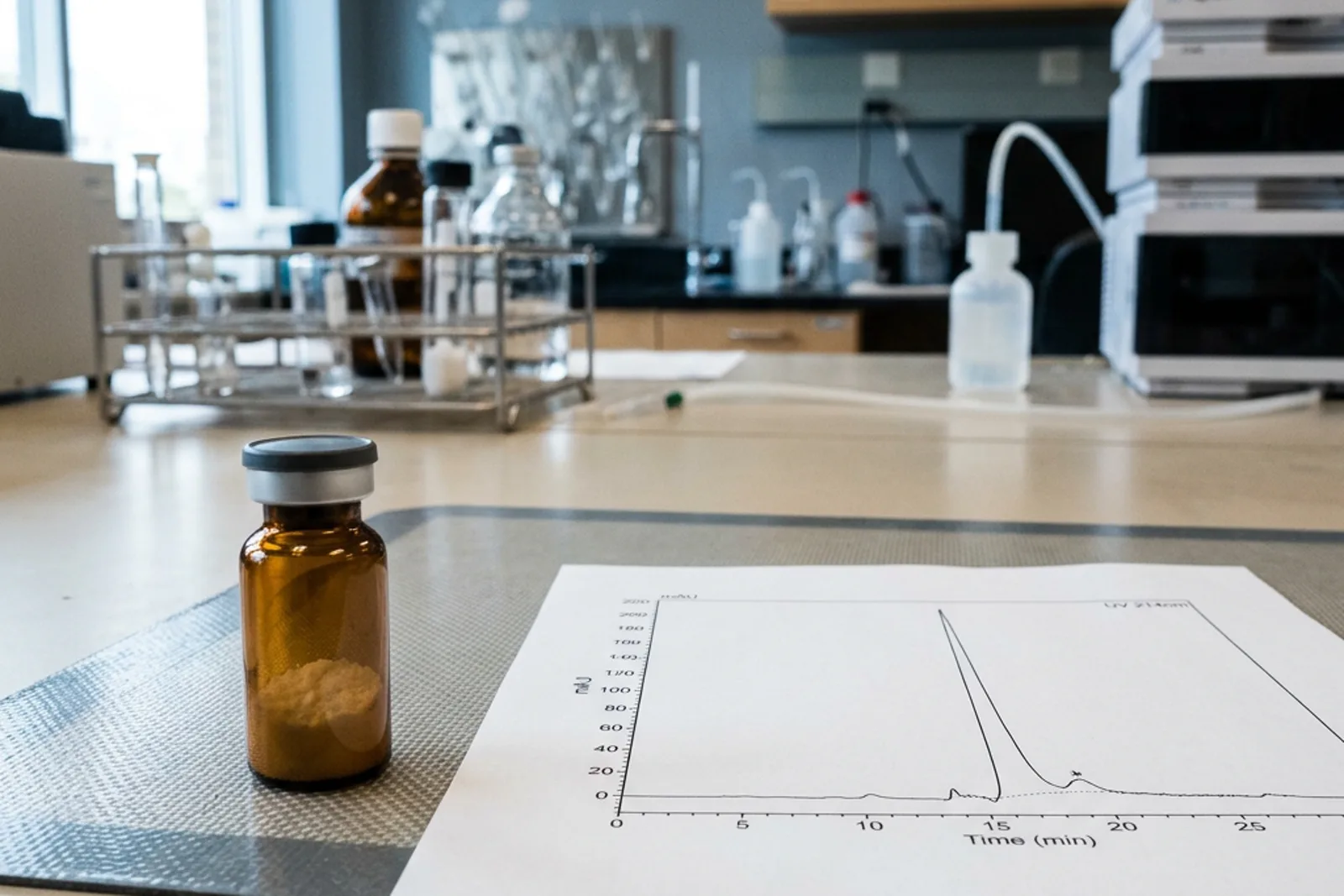
That comes down to three things a research buyer can verify: identity confirmed by mass spectrometry, purity quantified by HPLC (≥98% is the working bar for assay-grade peptide), and a batch-specific certificate of analysis rather than a generic spec sheet. Cold-chain handling matters too, because lyophilized hexapeptides are stable dry but degrade once reconstituted. The broader sourcing logic — COAs, HPLC verification, and the red flags that separate research-grade suppliers from repackagers — is covered in our guide on peptide purity and HPLC testing, and the handling specifics live in the peptide reconstitution and handling guide.
For the wider GH secretagogue class — how GHRP-6 sits relative to GHRH analogs, ghrelin mimetics, and the selective later-generation compounds — see our growth hormone secretagogues guide. Researchers working the GHRH side of the axis frequently pair their reading with the CJC-1295 DAC vs No-DAC pharmacokinetics breakdown.
Frequently asked research questions
What receptor does GHRP-6 act on?
GHRP-6 is an agonist at the growth hormone secretagogue receptor, GHS-R1a — the same G-protein-coupled receptor later shown to be the endogenous target of ghrelin (Kojima et al., 1999). It was characterized as a synthetic activator of this receptor years before the receptor itself was cloned.
How does GHRP-6's mechanism differ from GHRH?
In cultured human somatotroph studies, GHRP-6 stimulated GH secretion through the phosphatidylinositol/PKC/calcium pathway in a cAMP-independent manner (Lania et al., 1995), whereas GHRH signals largely through cAMP/PKA. The two act on different receptors and, in animal models, produce a larger combined GH response than either alone.
Why is GHRP-6 associated with appetite in the research literature?
Because GHS-R1a is the ghrelin receptor, and ghrelin is a well-documented appetite-stimulating hormone. GHRP-6, as a GHS-R1a agonist, reproduces aspects of that signaling in animal models — which is why the research record frequently notes a hunger response and uses it to distinguish GHRP-6 from more selective secretagogues.
Is GHRP-6 only studied for growth hormone effects?
No. A separate preclinical literature examines GHRP-6 binding to GHS-R and CD36 in cardiac and other tissues, exploring cytoprotective signaling independent of GH. These are animal and in-vitro findings, not clinical outcomes, but they are an active area of investigation.
What purity standard applies to GHRP-6 for laboratory work?
Assay-grade research peptide is generally characterized to ≥98% by HPLC with identity confirmed by mass spectrometry and a batch-specific certificate of analysis. Reproducing the receptor and second-messenger studies cited here depends on starting from well-characterized material.
All compounds discussed are for in-vitro research and laboratory use only. Not intended for human or animal consumption. Always consult published literature and institutional guidelines before designing research protocols.
Frequently Asked Questions
What receptor does GHRP-6 act on?
<a href="/product/ghrp-6-5mg">GHRP-6</a> is an agonist at the growth hormone secretagogue receptor, GHS-R1a, later shown to be the endogenous target of ghrelin (Kojima et al., 1999). It was characterized as a synthetic activator years before the receptor was cloned.
How does GHRP-6's mechanism differ from GHRH?
In cultured human somatotroph studies, <a href="/product/ghrp-6-5mg">GHRP-6</a> stimulated GH secretion through the phosphatidylinositol/PKC/calcium pathway in a cAMP-independent manner (Lania et al., 1995), whereas GHRH signals largely through cAMP/PKA. They act on different receptors.
Why is GHRP-6 associated with appetite in the literature?
Because GHS-R1a is the ghrelin receptor, and ghrelin is a well-documented appetite-stimulating hormone. As a GHS-R1a agonist, <a href="/product/ghrp-6-5mg">GHRP-6</a> reproduces aspects of that signaling in animal models.
Is GHRP-6 only studied for growth hormone effects?
No. A separate preclinical literature examines <a href="/product/ghrp-6-5mg">GHRP-6</a> binding to GHS-R and CD36 in cardiac and other tissues, exploring cytoprotective signaling independent of GH. These are animal and in-vitro findings, not clinical outcomes.
What purity standard applies to GHRP-6 for laboratory work?
Assay-grade research peptide is generally characterized to at least 98% by <a href="/blog/peptide-purity-hplc-testing-guide">HPLC</a> with identity confirmed by mass spectrometry and a batch-specific certificate of analysis.