Melanotan-II: The Arizona Sun-Defense Project That Became a Research Compound
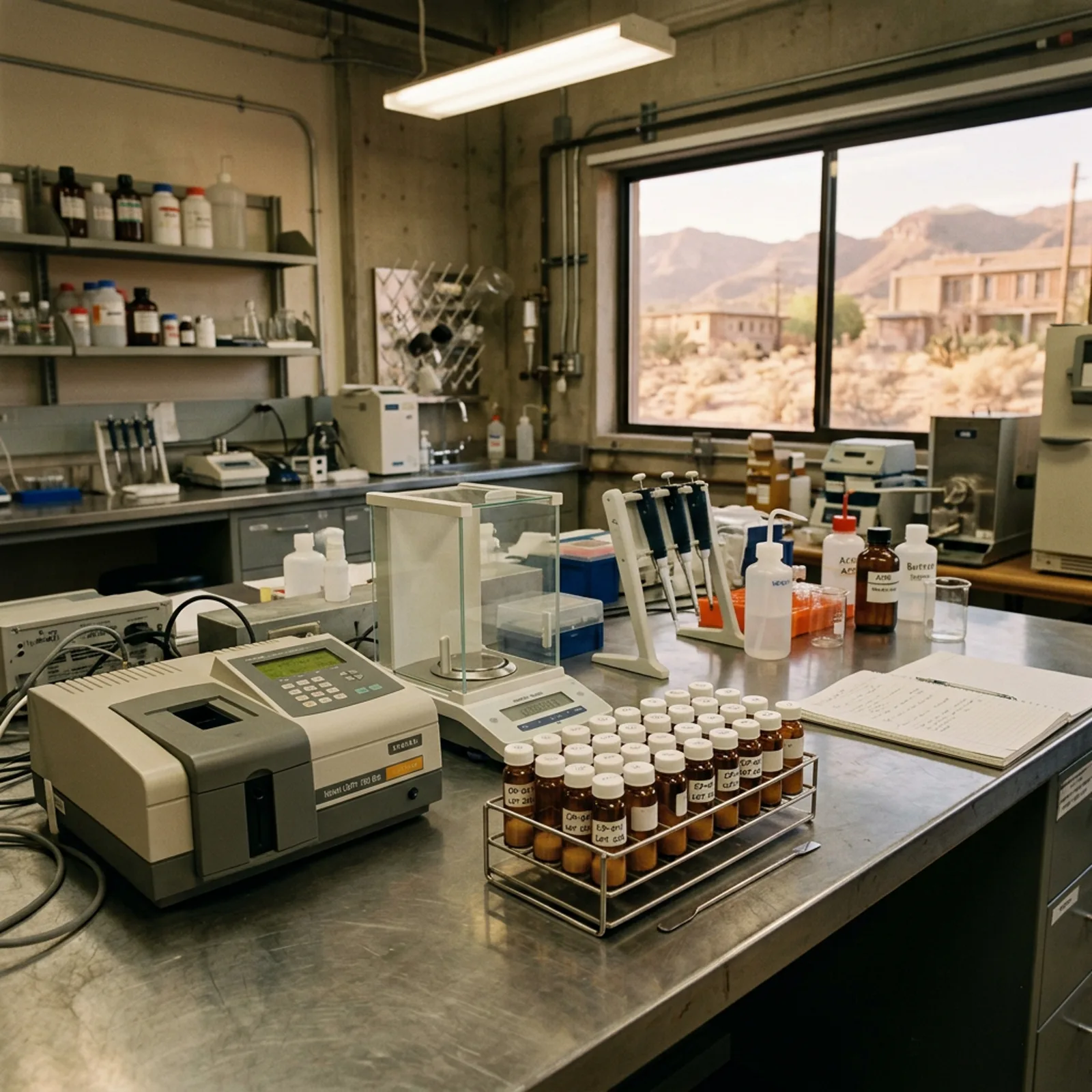
Melanotan-II started in a 1980s University of Arizona lab trying to prevent melanoma by inducing tanning without UV. The clinical program ended, but the molecule became one of the most studied non-selective melanocortin agonists in research literature.
The Original Target Was Melanoma Prevention
Victor Hruby ran a medicinal chemistry group at the University of Arizona through the 1980s and 1990s that turned out a remarkable number of melanocortin analogs. The original motivation wasn't sexual function or pigmentation per se — it was skin cancer. Arizona has one of the highest skin cancer rates in the United States. The Hruby lab was working on the question of whether a peptide that induced melanogenesis without UV exposure could be a primary-prevention tool for at-risk populations.
Native alpha-melanocyte stimulating hormone (alpha-MSH) is the obvious starting point. It's the endogenous ligand that drives melanogenesis through the MC1R receptor on melanocytes. The problem with using native alpha-MSH as a drug is that it has a half-life measured in minutes. The Hruby group's contribution was to engineer cyclic and substituted analogs with vastly extended pharmacokinetics. Melanotan-II, a cyclic heptapeptide, was one of the most stable.
The Cyclic Backbone
Melanotan-II's structure is Ac-Nle-cyclo[Asp-His-D-Phe-Arg-Trp-Lys]-NH2. The cyclization between Asp and Lys is what stabilizes the active conformation and gives the molecule its long-lived activity at the receptor. Compared to alpha-MSH, Melanotan-II is roughly 1,000-fold more potent at melanocortin receptors and stable for hours rather than minutes.
Critically, that potency is not selective. Melanotan-II is active across MC1R (pigmentation), MC3R and MC4R (centrally expressed, involved in appetite, sexual function, and cardiovascular regulation), and MC5R (sebaceous and exocrine function). The Hruby group recognized this from the beginning. The non-selectivity is what generated the molecule's wide pharmacological footprint and what eventually drove the development of more selective derivatives.
The Sexual Function Discovery
The story usually told about Melanotan-II involves a self-experimentation episode at Arizona — a researcher administered a higher dose than planned and reported spontaneous erection. Whether the anecdote is exact, the published clinical observation is real: in early Phase I work, male subjects receiving Melanotan-II reported erectile activity at frequencies above what would be expected from a tanning agent. This observation was investigated systematically, and it's what eventually spun off the PT-141 (bremelanotide) program at Palatin Technologies.
PT-141 was designed as a selective MC4R agonist — the receptor most directly implicated in central sexual response — to capture the sexual function effect without the off-target activity of the parent molecule. PT-141 is what eventually got FDA-approved for hypoactive sexual desire disorder in premenopausal women, marketed as Vyleesi. Melanotan-II's clinical development for tanning never advanced past early Phase trials.
Why the Tanning Program Stalled
Two reasons, depending on who you ask. The pharmacological reason is that the dose-response window between meaningful melanogenesis and side effects (nausea, flushing, blood pressure changes, sexual responses, appetite suppression) was narrow. A drug that induces a useful tan but reliably also produces those off-target effects is hard to position as a public-health product.
The commercial reason is that the indication itself — primary prevention of skin cancer in healthy people — is one of the hardest categories for drug development. The market is enormous in principle, but the trial endpoints are slow (cancer prevention requires years of follow-up), the placebo arms are ethically complex, and the regulatory bar is appropriately high. Investors looking at melanocortin chemistry made the rational decision to pursue indications with shorter trial timelines and clearer endpoints.
The Research Literature That Continued
Even after the clinical program wound down, academic research on Melanotan-II continued at substantial volume. The non-selective receptor profile that made it commercially difficult also made it scientifically useful. If you want to study melanocortin biology across MC1R through MC5R simultaneously, Melanotan-II is one of the best-characterized tool compounds available.
Published applications include studies of central appetite regulation (MC3R/MC4R), peripheral cardiovascular effects, sexual response circuits, melanogenesis kinetics in cultured melanocytes, and inflammation modulation through MC1R on immune cells. The literature is dense and spans neuroscience, dermatology, endocrinology, and immunology.
What Researchers Should Know
For laboratory research, Melanotan-II is useful precisely because it is non-selective. It allows broad melanocortin pathway interrogation without the need to deconvolute selective receptor signaling. The published dosing ranges in animal models are well-documented across rodent species. Stability and reconstitution behavior are characterized.
What the research record does not establish is human safety for repeated dosing in any indication. The clinical program at Arizona-and-beyond never accumulated the kind of long-term human exposure data that approved drugs require. The published Phase I work establishes acute tolerability at the trial doses; it does not establish chronic safety.
This is the standard caveat for most research peptides, but it is worth restating in the context of Melanotan-II specifically because the molecule has had a complicated public-facing history outside research labs. The published clinical record is narrower than the public chatter sometimes implies.
Sources: Hruby et al., Journal of Medicinal Chemistry, 1995 (Melanotan-II structural characterization); Dorr et al., Life Sciences, 1996 (Phase I human trial data); Wessells et al., Journal of Urology, 1998 (sexual function observations); Palatin Technologies SEC filings, 2000-2019 (PT-141 development history derived from MT-II program).
Frequently Asked Questions
Where did Melanotan-II originate?
It came out of Victor Hruby's medicinal chemistry group at the University of Arizona in the 1980s. The original target was a tanning agent that could induce melanogenesis without UV exposure, as a melanoma-prevention strategy.
Is Melanotan-II FDA-approved?
No. The original sun-defense clinical program never advanced to approval. <a href="/product/pt-141-10mg">Bremelanotide</a> (PT-141), a related selective MC4R agonist derived from the same chemical lineage, was later approved for hypoactive sexual desire disorder under the brand name Vyleesi — but Melanotan-II itself remains a research compound.
What does the research literature describe?
Melanotan-II is a non-selective melanocortin receptor agonist active at MC1R, MC3R, MC4R, and MC5R. Published studies cover melanogenesis, sexual function (which is what spun off the <a href="/product/pt-141-10mg">PT-141</a> program), appetite suppression, and cardiovascular effects. The non-selective receptor profile is what generated both interest and concern relative to selective derivatives.