 PopularFor research use only
Sexual Health / Melanocortin Agonists
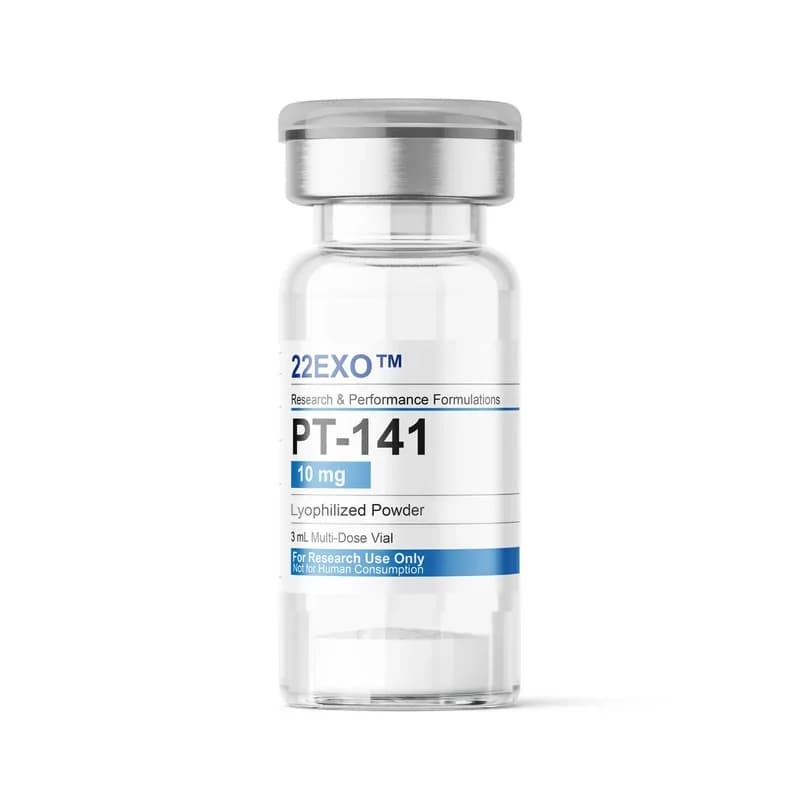
PT-141 10mg
Research gradeSynthetic cyclic heptapeptide and selective MC3R/MC4R melanocortin receptor agonist (INN: Bremelanotide). A reference compound in melanocortin pathway research, with a stable cyclic lactam structure and well-characterized pharmacokinetic profile.
- ≥99% purity
- Third-party COA on file
- Cold packs when needed
Only 9 left in stock.
Free standard shipping on orders over $200.00 · Discreet packaging
| 1 vial | $98.00 | |
| 2 vials | $93.10 | Save 5% |
| 3 vials | $88.20 | Save 10% |
| 4 vials | $83.30 | Save 15% |
| 5–9 vials | $78.40 | Save 20% |
| 10+ vials | $73.50 | Unavailable — only 9 in stock |
Tiers apply to the quantity on each cart line; a Subscribe & Save line is priced separately from a one-time line.
- Purity
- ≥99%
- Strength
- 10mg
- CAS
- 189691-06-3
- Formula
- C50H68N14O10
- Form
- Lyophilized Powder
- Vial
- 3 mL Multi-Dose Vial
Sequence: Ac-Nle-cyclo[Asp-His-D-Phe-Arg-Trp-Lys]-OH
Download certificate of analysis (PDF)Ordering for an institution? Volume pricing and purchase orders are available. Wholesale program → · Contact support
Commonly researched together
Hand-picked companion compounds for research alongside PT-141 10mg.
Total for 3 items: $224.00
Overview
PT-141 (Bremelanotide) is a cyclic heptapeptide and synthetic melanocortin receptor analogue, derived from Melanotan II research and originally developed by Palatin Technologies. It is one of the most extensively characterized selective MC3R/MC4R agonists in the published melanocortin literature, with a well-documented pharmacokinetic profile, structural data, and central-nervous-system mechanism. The 10mg lyophilized format supports extended in-vitro research, receptor-binding assays, and structure–activity relationship studies in melanocortin pathway investigation.
Mechanism
PT-141 is a selective agonist at the melanocortin-3 (MC3R) and melanocortin-4 (MC4R) receptors, both densely expressed in the hypothalamus (medial preoptic area, paraventricular nucleus) and limbic system. The cyclic lactam bridge between the Asp⁵ and Lys¹⁰ residues provides superior metabolic stability compared with linear melanocortin analogues, supporting a reported plasma half-life of approximately 2.7 hours in published pharmacokinetic studies. Unlike PDE5 inhibitors, PT-141 acts upstream of vascular signaling, providing a chemically distinct probe of central melanocortin receptor activity. Reported research applications include MC4R receptor-binding assays, fMRI-based central-pathway studies, cAMP-pathway signaling research, and structure–activity comparison against the parent Melanotan II scaffold.
Published research
- 1Selective high-affinity agonism at MC3R and MC4R, with reduced MC1R activity relative to the parent Melanotan II scaffold (Hruby et al., 2003)
- 2Reported plasma half-life of approximately 2.7 hours in published pharmacokinetic literature, supporting time-course study designs
- 3fMRI studies in human research subjects have characterized increased activation in hypothalamic, limbic, and reward-processing regions following administration
- 4Cyclic lactam structure (Asp⁵–Lys¹⁰ bridge) provides improved hydrolytic stability versus linear α-MSH analogues, useful for stability and degradation studies
- 5Frequently used as a reference compound in melanocortin receptor structure–activity-relationship (SAR) and binding-affinity research
Methodology note: This product summary references published preclinical and clinical research. 22EXO does not make therapeutic claims. All compounds are sold strictly for laboratory and research applications.
Disclaimer: For in-vitro laboratory research use only. Not for human or veterinary use. By purchasing, you agree to our terms of service and confirm that this product will only be used for legitimate research purposes.
Customer reviews
No reviews yet for PT-141 10mg.
Bought it? Be the first to share how it arrived — packaging, documentation, solubility. Reviews from purchasers are marked Verified Buyer.
Related research
All articlesMelanotan-II: The Arizona Sun-Defense Project That Became a Research Compound
Melanotan-II started in a 1980s University of Arizona lab trying to prevent melanoma by inducing tanning without UV. The clinical program ended, but the molecule became one of the most studied non-selective melanocortin agonists in research literature.
9 min readSexual HealthPT-141 / Bremelanotide: From the Tan-Sex Sunscreen to FDA Approval and Back
PT-141 has one of the more unusual development histories in peptide pharmacology. It started as a melanocortin tanning agent, became a sexual function drug after researchers noticed an unexpected side effect, got FDA-approved as Vyleesi in 2019, and continues as a research tool for melanocortin receptor pharmacology.
9 min readSexual HealthPT-141 (Bremelanotide): From NASA Sunscreen Accident to FDA-Approved Sexual Health Peptide
PT-141 (bremelanotide) began with an accidental self-injection at the University of Arizona and ended as FDA-approved Vyleesi. The research history spanning Melanotan II's discovery through the RECONNECT Phase 3 trials illuminates the melanocortin-4 receptor mechanism underlying sexual desire.
13 min read