Why BPC-157, TB-500, and GHK-Cu Get Stacked Together: The Mechanism Map
Three peptides, three different cellular processes, one tissue-repair logic. The combination has become one of the most-used research stacks. Here is the mechanistic case for why — and what the evidence actually supports.
Three Stages of Tissue Repair
Tissue repair, in any vertebrate, follows roughly the same sequence. Inflammation comes first — damage signals draw immune cells to the injury site and clear debris. Then proliferation: progenitor cells migrate into the wound, divide, and lay down provisional matrix. Finally remodeling: the disorganized provisional matrix is reorganized into mature, mechanically appropriate connective tissue. The stages overlap but the sequence is consistent across wound types.
Each stage has its molecular bottlenecks. Inflammation requires controlled cytokine signaling and timely macrophage polarization. Proliferation requires available progenitor cells, intact growth factor signaling, and adequate vascularization to support metabolic demands. Remodeling requires functional connective tissue enzymes — particularly the copper-dependent crosslinking machinery — and the right balance of synthesis and degradation.
The BPC-157 + TB-500 + GHK-Cu stack maps onto these stages, somewhat. BPC-157 has effects across all three. TB-500 contributes most heavily to proliferation. GHK-Cu contributes most heavily to remodeling. The combination logic isn't that any single peptide is doing the whole job. It's that together they cover more of the process than any one of them does alone.
What BPC-157 Does
BPC-157's mechanism is unusually broad for a 15-residue peptide. The published literature documents effects on growth factor signaling (particularly VEGF and FGF pathways), nitric oxide system function, FAK-paxillin signaling, vascular endothelial integrity, and cell survival under oxidative stress. Sikiric and the Zagreb group have argued for years that BPC-157 acts as a system-level modulator rather than through a single receptor pathway, and the data is consistent with that framing.
For tissue repair specifically, the most robust effects are vascular and cytoprotective. BPC-157 promotes angiogenesis at injury sites, which is critical for sustaining cell metabolism in the proliferative phase. It also maintains endothelial function under conditions that would otherwise produce vascular dysfunction (Sikiric, Inflammopharmacology, 2014). And it increases cell survival under oxidative stress, which matters because the wound environment is metabolically harsh.
What TB-500 Does
TB-500 is the migration peptide. The full thymosin beta-4 protein, of which TB-500 is the central active fragment, is the major G-actin sequestering protein in vertebrate cells. Cells need a substantial G-actin pool to fuel rapid F-actin polymerization at the leading edge during migration. Without it, cells stall.
For wound repair, this matters because the proliferative phase requires fibroblasts, endothelial cells, and keratinocytes to migrate into the wound site from surrounding tissue. The Malinda 1999 paper in J Invest Dermatol established the dose-response relationship for thymosin beta-4 in epithelial wound closure, and subsequent work extended the findings to other migrating cell types. TB-500 doesn't promote cell division directly — it ensures the cells that do divide can move where they need to go.
What GHK-Cu Does
GHK-Cu's contributions are at the matrix-remodeling end of the repair sequence. The Maquart group at Reims established in the late 1980s and early 1990s that GHK-Cu stimulates connective tissue synthesis in dermal fibroblasts — increased collagen, elastin, glycosaminoglycan, and proteoglycan production. The Mulder 1994 wound-healing trial extended the evidence into clinical contexts.
The mechanistic story is more complex than 'GHK-Cu makes more collagen.' GHK-Cu also modulates the matrix metalloproteinase / tissue inhibitor of metalloproteinase balance, which controls how the provisional wound matrix is reorganized over time. It supports lysyl oxidase function, the copper-dependent enzyme that crosslinks collagen and elastin into mature mechanical structures. And the Hong 2010 BMC Genomics paper documented broad gene expression effects across pathways involved in repair, oxidative defense, and inflammation resolution.
The Stack's Mechanistic Coverage
Read together, the three peptides cover most of the major tissue repair processes. BPC-157 addresses vascular function and cell survival across all repair phases. TB-500 addresses cell migration during proliferation. GHK-Cu addresses matrix synthesis and remodeling during the repair phase. Each peptide does things the others don't.
This is the mechanistic basis for combining them. It's a defensible argument from molecular biology. It's not the same as a controlled trial showing the combination outperforms any component. That trial doesn't exist. The stack rationale rests on the inference that addressing multiple sequential processes should produce better outcomes than addressing one — which is plausible but unproven.
The KPV Addition
A four-peptide variant of the stack adds KPV, the C-terminal tripeptide of α-MSH. KPV's primary mechanism involves anti-inflammatory signaling through NF-κB and related pathways, which addresses the inflammation phase that BPC-157, TB-500, and GHK-Cu only partially modulate. The addition is mechanistically reasonable for research models where inflammation is the rate-limiting step in repair, particularly chronic wound models.
KPV is also small (3 residues) and well-tolerated in published animal work, which makes the addition low-cost in terms of additional pharmacological complexity. Research applications studying inflammatory wound models or barrier dysfunction (intestinal mucositis, for example) sometimes prefer the four-peptide blend over the three-peptide version for this reason.
What's Open
The biggest open question for this stack family is the comparative efficacy question. We don't know how much value the combination adds over the best single component for any given research model. We don't have controlled trials directly comparing the three-peptide blend to BPC-157 alone, or to TB-500 alone, in tendon repair or wound healing models. The stack rationale is mechanistic; the comparative effect-size data is missing.
For research applications where the goal is exploratory characterization of multi-peptide effects in a specific tissue model, the stack is a reasonable starting point. For research applications requiring specific causal attribution to one peptide or another, single-component protocols are necessary. The stack and the components are complementary research tools rather than substitutes.
Storage and Practical Notes
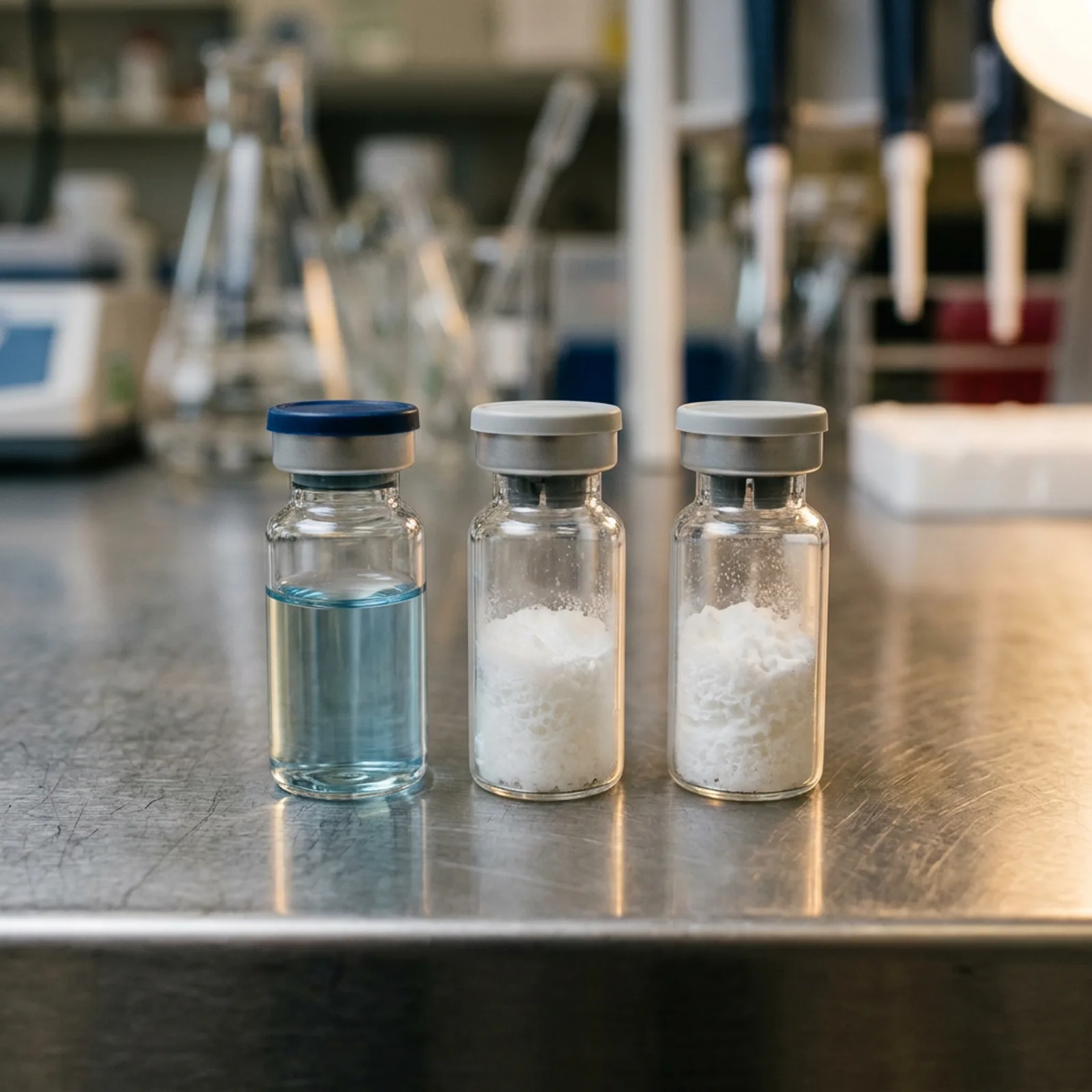
Stack blends are sold as single lyophilized vials containing all three (or four) peptides at documented ratios. Reconstitution should produce a clear, slightly blue solution (the blue is from GHK-Cu). Persistent cloudiness suggests aggregation or incomplete dissolution and may indicate quality issues. Each component peptide should be documented separately on the COA — total peptide content alone is insufficient because it doesn't establish the ratios. Reputable suppliers report individual peptide purities and the blend ratio separately.
For research design, the convenience of pre-blended products has to be weighed against the loss of dosing flexibility. If the experimental design requires varying the BPC-157:TB-500 ratio across arms, separate single-component vials are necessary. If the design is using a fixed combination ratio across all arms, the blend product saves preparation time and reduces variability in reconstitution.
Sources: Sikiric et al., Curr Pharm Des, 2010 (BPC-157 mechanism); Malinda et al., J Invest Dermatol, 1999 (TB-500 wound healing); Maquart et al., FEBS Letters, 1988 (GHK-Cu collagen synthesis); Hong et al., BMC Genomics, 2010 (GHK gene expression); Pickart and Margolina, Int J Mol Sci, 2018; Catania et al., Pharmacol Rev, 2010 (KPV/melanocortin anti-inflammatory).
Frequently Asked Questions
Are these three peptides synergistic in published trials?
There is no published controlled trial of the <a href="/product/bpc-157-tb-500-ghk-cu-blend">BPC-157 + TB-500 + GHK-Cu</a> combination tested against any single component or against any pair. The synergy claim rests on mechanistic complementarity — each peptide acts on a different cellular process involved in tissue repair — not on direct comparative trial data. This is an important distinction. The combination is mechanistically defensible. It is not clinically proven to outperform individual components.
What does each peptide actually contribute?
<a href="/product/bpc-157-5mg">BPC-157</a> promotes growth factor signaling, vascular function, and cell survival under stress. TB-500 maintains the G-actin pool that enables cell migration into wound sites. <a href="/product/ghk-cu-50mg">GHK-Cu</a> provides copper for matrix remodeling enzymes and modulates a broad set of genes involved in tissue repair. The three operate at different stages and on different cellular processes — recruitment, migration, remodeling — which is the basis of the mechanistic stacking case.
Why is GHK-Cu in particular added to the BPC + TB combination?
<a href="/product/bpc-157-5mg">BPC-157</a> and TB-500 don't address connective tissue matrix remodeling directly. <a href="/product/ghk-cu-50mg">GHK-Cu</a> does. It provides copper for lysyl oxidase, the key enzyme in collagen and elastin crosslinking, and it modulates expression of matrix metalloproteinases and tissue inhibitors of metalloproteinases. For research models involving structural tissue repair (tendon, ligament, dermal matrix), the addition of GHK-Cu addresses a process the other two compounds don't directly target.