GHK-Cu: The Copper Peptide That Reorganizes Itself in Aging Skin
GHK is a tripeptide that copper finds. The Pickart lab spent four decades showing what happens when it does. From a 1973 plasma fraction to over 60 published papers on wound healing, dermal remodeling, and gene expression, here is the research record.
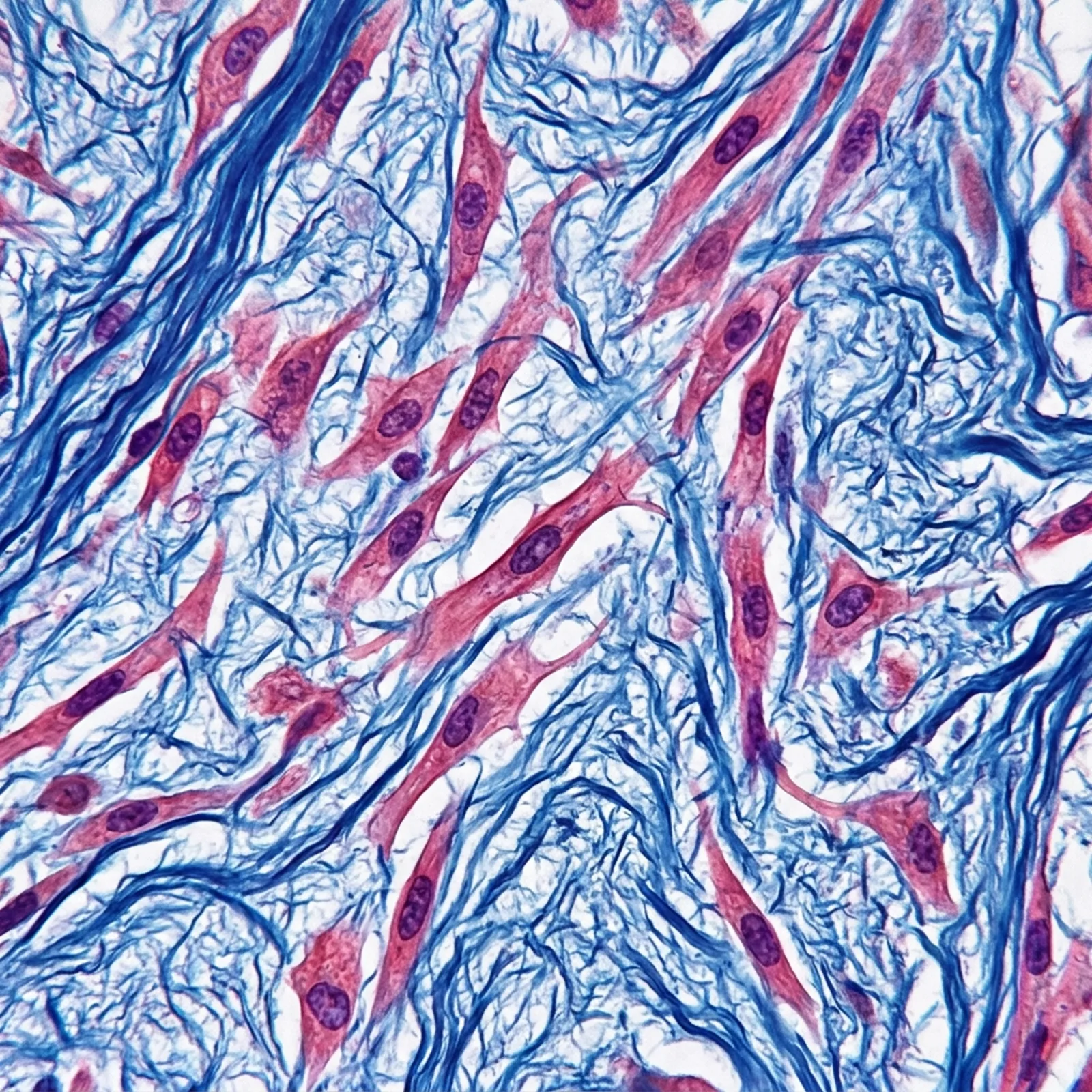
A Plasma Fraction from 1973
The story starts in San Francisco. In the early 1970s, Loren Pickart was a graduate student working on a question that sounds simple and was not: when you co-culture old liver cells with young liver cells, the old cells start behaving like young cells. What is the signal?
The activity tracked to a small molecule. After years of fractionation, Pickart isolated it from human plasma and identified its structure. It was a tripeptide — glycyl-histidyl-lysine, three amino acids in a row. He published it in Nature in 1973 (Pickart and Thaler, Nature New Biology, 1973). It was an unusual finding to come out of a thesis project, and at the time it wasn't obvious what to do with it.
What made GHK different from a thousand other small bioactive peptides discovered in that era was a quirk of chemistry. Histidine, the central residue, has a side chain that grabs copper ions with extraordinary affinity. So does lysine, less aggressively, on the other side. With glycine completing the geometry, the three residues fold around a copper ion and lock it in place. The complex is stable enough that GHK in human blood circulates almost exclusively in the copper-bound form. From the outset, the molecule of interest was GHK-Cu, not GHK alone.
The Copper Question
This matters because most of what GHK-Cu does requires the copper. Pickart's later mechanistic work, much of it published through the 1980s and 1990s, kept returning to this point. Strip the copper out and you get a peptide that binds tissue and gets ignored. Add the copper back and the cellular response returns. The complex isn't GHK with copper as an accessory. The copper is part of the active signal.
Not every cellular response to GHK-Cu is copper-dependent in the simple sense. Some appears to involve copper delivery to copper-requiring enzymes — lysyl oxidase, a key enzyme in collagen and elastin crosslinking, is a notable example. Other responses involve the GHK-Cu complex acting on receptor systems independent of copper transport. The Pickart lab's review papers (Pickart, J Cosmet Sci, 2008; Pickart and Margolina, Int J Mol Sci, 2018) lay out the mechanistic picture in detail and acknowledge that not every signaling pathway is fully resolved.
What Maquart's Group Found in Reims
The wound-healing case for GHK-Cu was built mostly outside the United States. François Maquart's group at the University of Reims published a series of papers in the late 1980s and early 1990s that established GHK-Cu as a stimulus for connective tissue remodeling. The 1988 paper in FEBS Letters showed GHK-Cu increased glycosaminoglycan synthesis in fibroblast culture. A 1993 paper in Journal of Investigative Dermatology reported elevated collagen and elastin synthesis in skin punch biopsies treated with GHK-Cu compared with vehicle controls.
The clinical translation came in 1994. Mulder and colleagues, working with chronic pressure ulcers, ran a controlled trial of GHK-Cu cream against vehicle. Their report in Wound Repair and Regeneration documented accelerated healing in the GHK-Cu arm. The effect size was modest, the patient population was small, and it remains one of the few human trials in the GHK-Cu literature. But it was a real signal in a real clinical context, not a cell culture artifact.
The 2010 Gene Expression Paper That Changed the Frame
For decades GHK-Cu was discussed as a wound-healing factor and a copper-transport peptide. Then in 2010, Hong, Downey, Pickart and colleagues published a microarray study in BMC Genomics that did not fit either frame.
They exposed cultured human fibroblasts to GHK at 1 nanomolar — a concentration close to physiological levels in plasma — and looked at gene expression changes across the entire transcriptome. The result was striking. GHK significantly modulated the expression of 4,192 human genes. Roughly 31% were upregulated, 69% downregulated. The functional categories spanned wound repair, antioxidant defense, anti-inflammatory pathways, DNA repair, nervous system signaling, and ubiquitin-mediated protein turnover.
The paper has been cited several hundred times. It reframed GHK from a tissue-repair factor with a known mechanism to a broad transcriptional modulator whose mechanism was no longer simple to summarize. Subsequent work, including a 2012 Pickart paper in Annals of the New York Academy of Sciences, focused on the genes whose expression GHK-Cu reverses in aged versus young fibroblasts. The pattern was consistent: GHK-Cu shifts the transcriptional state of older cells back toward a younger profile in many of the gene categories where aging produces the largest shifts.
Skin: Photoaging, Pigmentation, Barrier
The skin literature is where GHK-Cu has accumulated the most independent replication. Multiple labs have shown that GHK-Cu applied topically increases procollagen-1 levels in human skin biopsies, improves elasticity measurements on cutometer testing, and reduces the appearance of fine wrinkles in placebo-controlled cosmetic studies. Abdulghani et al. in 1998 (Skin Pharmacol) was an early human study; Leyden et al. in 2002 added comparative data versus vitamin C and retinoic acid in a controlled cosmetic dermatology setting.
The mechanistic side has more open questions. GHK-Cu appears to upregulate decorin, a small leucine-rich proteoglycan involved in collagen fibril spacing and wound matrix organization (Simeon et al., Lab Invest, 2000). It increases expression of metalloproteinases and their tissue inhibitors in patterns that suggest active remodeling rather than pure synthesis. And in a 2015 paper in Biogerontology, Pickart and colleagues argued the gene expression signature in skin overlaps substantially with the signature in liver — supporting the original 1973 observation that started the whole project.
Hair Follicles, Stem Cells, and the Ongoing Argument
One of the more contested claims for GHK-Cu involves hair follicle stem cells. Trachy and colleagues at Procyte Corporation (the company Pickart co-founded to commercialize GHK-Cu) reported that the peptide enlarged hair follicles in animal models. The 1992 patent and subsequent publications described follicle perimeter increases of roughly 100% in some experimental conditions. Independent replication in academic settings has been more limited, and the mechanism is incompletely understood. Recent work in 2022 (Int J Mol Sci) revisited the dermal papilla cell response to GHK-Cu and reported gene expression signatures consistent with the older claims, but the field hasn't converged on a definitive picture.
Stem-cell-related effects more broadly are an active research area. GHK-Cu has been reported to mobilize bone marrow-derived progenitor cells in animal injury models, potentially through SDF-1 signaling. The evidence is suggestive rather than conclusive — these are difficult experiments to do well, and the signaling networks involved are dense.
What the Research Doesn't Show
It's worth being explicit. The published research record on GHK-Cu does not establish it as a treatment for any specific human condition. Most of the strongest evidence is from cell culture and animal models. The 1994 Mulder trial is small. The cosmetic dermatology trials are typically short, often industry-sponsored, and not powered to detect clinically meaningful differences across all skin parameters. The gene expression work is striking but doesn't, by itself, predict outcomes in a treated patient population.
What the research does establish is a coherent mechanistic story across five decades. GHK-Cu binds copper. It modulates a large set of genes involved in tissue maintenance, repair, and aging. It accelerates wound healing in animal models with a consistent effect size. It increases connective tissue synthesis in dermal fibroblasts. And the work all points back to a 1973 graduate student who asked why old liver cells in young company act young, and followed the answer for the next forty years.
Storage, Reconstitution, and Research Quality
For research applications, GHK-Cu is sold as a lyophilized blue powder — the blue is the copper. The intensity of the blue is one of the rougher quality checks: a near-colorless product is suspicious, since it suggests the copper loading is incomplete. Reconstituted in bacteriostatic water, GHK-Cu solutions are stable at 2–8°C for several weeks. Lyophilized vials stored at −20°C show no significant degradation over months in published stability studies. Any vendor's COA should report total peptide content, purity by HPLC, and copper loading by atomic absorption or ICP-MS — three numbers, not one.
The Pickart and Margolina 2018 paper in International Journal of Molecular Sciences remains the most comprehensive recent review and is freely available through PubMed Central. For anyone going deeper into the literature, that paper is the right starting point.
Sources: Pickart and Thaler, Nature New Biology, 1973; Maquart et al., FEBS Letters, 1988; Maquart et al., J Invest Dermatol, 1993; Mulder et al., Wound Repair Regen, 1994; Abdulghani et al., Skin Pharmacol, 1998; Leyden et al., J Cosmet Sci, 2002; Hong, Downey, Pickart et al., BMC Genomics, 2010; Pickart and Margolina, Int J Mol Sci, 2018.
Frequently Asked Questions
Who discovered GHK and when?
Loren Pickart isolated GHK from human plasma in 1973 while working on the question of why fetal liver cells could induce older liver tissue toward a younger phenotype in co-culture. The activity tracked to a low-molecular-weight fraction, which he eventually identified as the tripeptide glycyl-histidyl-lysine. He described the isolation in his University of California San Francisco doctoral work and published the structure in Nature (Pickart and Thaler, 1973).
Why is GHK studied as a copper complex (GHK-Cu) rather than alone?
GHK has an unusually high binding affinity for copper(II) ions. The complex it forms is exceptionally stable and is the form that exists physiologically — GHK in plasma is essentially fully copper-loaded under normal conditions. The biological activities Pickart described track to the <a href="/product/ghk-cu-50mg">GHK-Cu</a> complex, not GHK alone, because copper is required for several of the downstream signaling effects (Pickart 1980, J Cellular Physiol).
What is the strongest evidence for GHK-Cu in wound healing?
The Mulder et al. 1994 trial in Wound Repair and Regeneration showed accelerated healing of pressure ulcers in patients receiving <a href="/product/ghk-cu-50mg">GHK-Cu</a> cream versus vehicle controls. Animal studies are more extensive — Maquart and colleagues at Reims published a series in the early 1990s (J Invest Dermatol, 1993; FEBS Lett, 1988) showing GHK-Cu stimulated collagen, elastin, and proteoglycan synthesis in fibroblast culture and in vivo wound models.
What did the Hong et al. 2010 gene expression study find?
Hong, Downey, Pickart and colleagues published in BMC Genomics (2010) a microarray analysis showing GHK at 1 nanomolar concentration modulated the expression of 4,192 human genes. Genes upregulated included those involved in tissue remodeling, antioxidant defense, and DNA repair. Genes downregulated included those associated with inflammation and certain types of cell-cycle dysregulation. The paper has been cited several hundred times and reframed GHK from 'copper transporter' to a broad gene-modulating signal.
How is GHK-Cu different from KPV or other tripeptides?
KPV (Lys-Pro-Val) is the C-terminal tripeptide of α-MSH and acts primarily through anti-inflammatory pathways, including NF-κB modulation. <a href="/product/ghk-cu-50mg">GHK-Cu</a> is structurally and mechanistically distinct: it requires copper for its key activities, signals through different receptor systems (some evidence implicates collagen receptors and tissue inhibitors of metalloproteinases), and has a much broader gene expression footprint. They are sometimes combined in research blends because their mechanisms appear complementary rather than overlapping.