The CJC-1295 + Ipamorelin Stack: Research Rationale and Synergy Data
CJC-1295 and Ipamorelin target different receptor systems — GHRH receptors and GHS-R1a respectively — creating synergistic GH pulses that exceed either compound alone. A mechanistic breakdown of why the combination works.
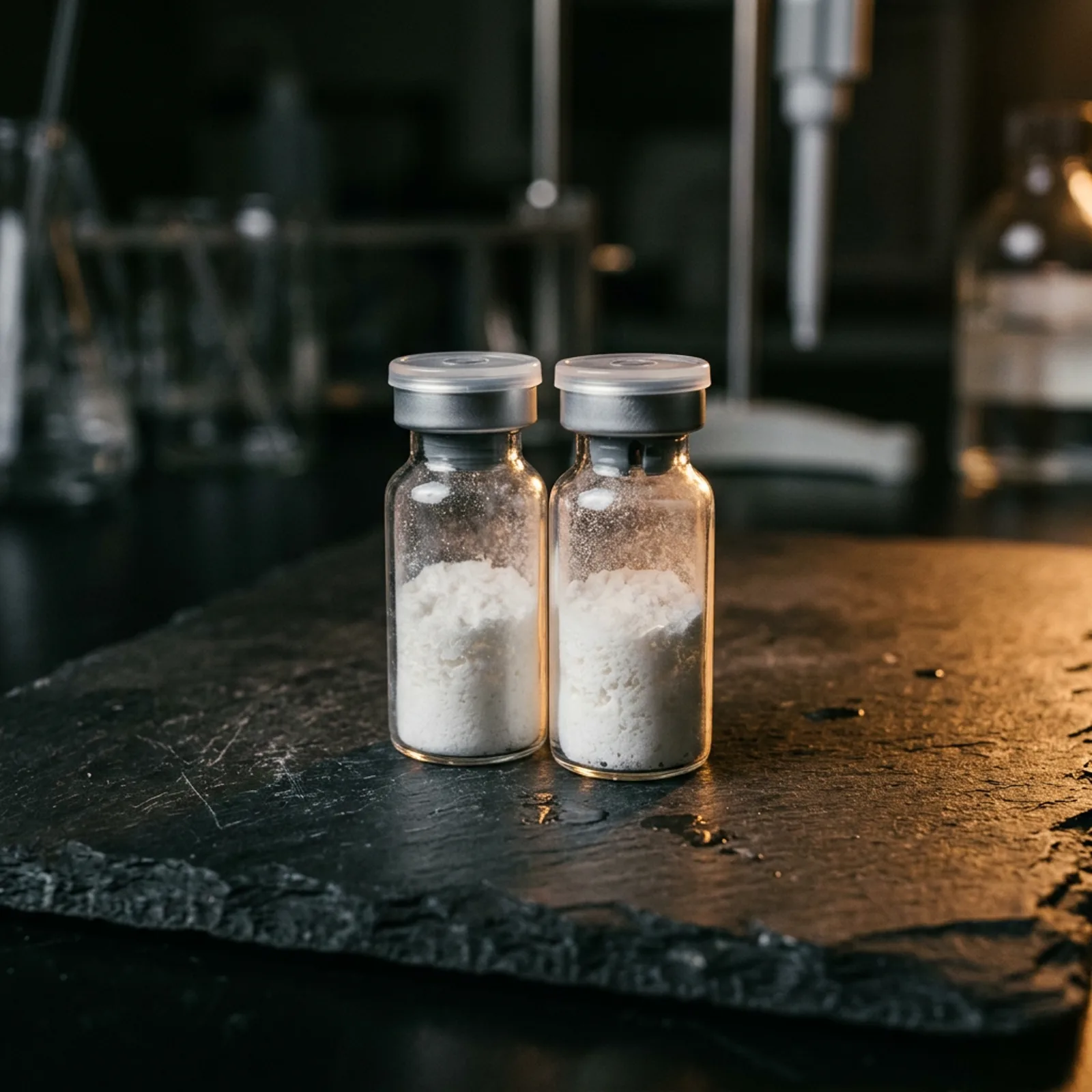
Of all the growth hormone secretagogue combinations studied, CJC-1295 + Ipamorelin is probably the most widely referenced — and for good reason. The two peptides work through distinct receptor systems, target different aspects of GH regulation, and when combined, produce a GH pulse that exceeds what either compound achieves alone. That's synergy in the pharmacological sense: greater than additive effects from complementary mechanisms.
Understanding why the combination works requires understanding each component separately first.
The GHRH System: Where CJC-1295 Operates
Growth hormone-releasing hormone (GHRH) is the primary hypothalamic stimulator of GH synthesis and secretion. It binds to GHRH receptors on somatotroph cells in the anterior pituitary, activating adenylyl cyclase, increasing cAMP, and triggering both GH gene transcription and the secretory release of pre-formed GH granules. GHRH doesn't just prompt existing GH to be released — it drives the production of more.
CJC-1295 (no-DAC version, also called Mod GRF 1-29) is a GHRH analog. It was engineered from the native GHRH(1-29) truncated sequence with four strategic amino acid substitutions that confer resistance to DPP-IV enzymatic degradation — extending its half-life from minutes to approximately 20–30 minutes. When administered, it binds GHRH receptors and stimulates GH release in a manner physiologically similar to endogenous GHRH.
Teichman and colleagues demonstrated in the Journal of Clinical Endocrinology & Metabolism (2006) — using the longer-acting DAC version — that CJC-1295 produces 2- to 10-fold increases in GH concentrations dose-dependently, with IGF-I levels elevated 1.5- to 3-fold. The no-DAC version produces equivalent acute peaks but clears rapidly, generating a defined pulse rather than sustained elevation.
Ipamorelin: The Selective GHRP
Ipamorelin belongs to a different class entirely — growth hormone-releasing peptides (GHRPs). Rather than binding the GHRH receptor, GHRPs bind the GHS-R1a receptor (the ghrelin receptor), triggering GH release through a calcium-dependent mechanism that operates independently of the GHRH pathway. The two receptor systems are distinct; blocking one doesn't eliminate the other's GH-releasing activity.
Raun and colleagues at Novo Nordisk published the defining ipamorelin characterization study in the European Journal of Endocrinology in 1998 — still the foundational reference for this compound. The paper described a pentapeptide (Aib-His-D-2-Nal-D-Phe-Lys-NH2) with GH-releasing potency and efficacy comparable to GHRP-6 in both in vitro pituitary cell assays and in vivo rat and swine models.
In anesthetized rats, ipamorelin's ED50 was 80 ± 42 nmol/kg with a maximal GH response (Emax) of 1,545 ± 250 ng GH/ml — comparable to GHRP-6 (ED50 = 115 ± 36 nmol/kg; Emax = 1,167 ± 120 ng GH/ml). In conscious swine, the ED50 was 2.3 ± 0.03 nmol/kg with an Emax of 65 ± 0.2 ng GH/ml — again essentially equivalent to GHRP-6's 3.9 ± 1.4 nmol/kg and 74 ± 7 ng GH/ml.
Potency roughly equivalent to GHRP-6. So why is ipamorelin considered superior? Because of what it doesn't do.
The Selectivity That Defines Ipamorelin
This is where Raun's 1998 paper gets genuinely interesting. Other GHRPs — GHRP-2 and GHRP-6 specifically — significantly elevate ACTH and cortisol levels when administered. These are stress hormones. Cortisol elevation is a common side effect concern with GHRPs, and it represents an off-target pharmacological effect that complicates interpretation of research results and creates physiological side effects that researchers want to avoid.
Ipamorelin showed essentially no effect on ACTH or cortisol in swine — even at doses more than 200-fold higher than the ED50 for GH release. Let that sink in. At 210 times the GH-effective dose, ipamorelin produced ACTH and cortisol plasma levels indistinguishable from those following GHRH stimulation. GHRP-6 at 85 times its GH ED50 and GHRP-2 at 45 times its GH ED50 both produced significant cortisol and ACTH responses.
FSH, LH, PRL, and TSH were also unaffected by ipamorelin in these studies. That's a remarkably clean GH-specific secretagogue profile — no prolactin, no cortisol, no thyroid or gonadal hormone disruption. Raun's group concluded that ipamorelin was the first GHRP-receptor agonist with a selectivity for GH release similar to that displayed by GHRH — which is a significant statement in context.
Why the Combination Produces Synergy
GH release from the pituitary is regulated by two opposing hormones: GHRH (stimulatory) and somatostatin (inhibitory). A GH pulse occurs when GHRH activity peaks while somatostatin tone is low. The timing matters — these two signals must align for robust GH release.
GHRPs like ipamorelin work through two mechanisms simultaneously: they activate GHS-R1a receptors to stimulate GH release, and they suppress somatostatin secretion, which removes the brake on GH release from the pituitary. GHRH analogs like CJC-1295 step on the accelerator. Ipamorelin both steps on the accelerator (via a different receptor) and releases the brake.
When both are present simultaneously:
- GHRH receptor activation drives GH synthesis and secretion
- GHS-R1a activation independently stimulates GH granule release
- Somatostatin suppression removes the inhibitory counterweight
The result is a GH pulse substantially larger than either compound can generate alone. The published literature on combined GHRH + GHRP administration consistently shows this super-additive pattern — the combination isn't merely additive, it's multiplicative.
Dosing Ratios in Published Protocols
The clinical and research literature doesn't converge on a single universal ratio, but several patterns emerge. Teichman's CJC-1295 pharmacokinetic work used 30–250 μg/kg ranges. Raun's ipamorelin work used nmol/kg quantities in animal models. In human research contexts, many protocols have explored equimolar or near-equimolar GHRH/GHRP combinations.
One practical consideration: because CJC-1295 no-DAC and ipamorelin have comparable half-lives (both in the 20–30 minute range when using the no-DAC version), they synchronize naturally. Both compounds peak together and clear together, creating a defined, coordinated pulse. This timing alignment is part of why the no-DAC version is generally preferred for combination protocols — the DAC version's multi-day half-life creates an always-on GHRH signal rather than a pulsatile one.
Research protocols commonly use the combination administered at night to capitalize on the natural circadian peak of GH secretion, which occurs in the first few hours of slow-wave sleep. Administering at this timing amplifies rather than overrides the body's endogenous GH rhythm.
What Research Goals Does This Combination Address?
The GHRH + GHRP combination is the most studied approach for GH axis stimulation in research contexts. Relevant research applications include:
- Body composition studies (lean mass, fat oxidation, muscle protein synthesis) where IGF-1 elevation is the primary dependent variable
- Recovery and tissue repair models where GH-mediated collagen synthesis and cellular regeneration are endpoints
- Sleep quality research, given GH's role in slow-wave sleep architecture
- Metabolic research examining GH's effects on insulin sensitivity and lipid metabolism
- GH deficiency model investigations, where stimulating endogenous secretion (rather than replacing exogenous GH) is the experimental intervention
One advantage of the secretagogue approach over exogenous GH administration is that the pituitary remains in control of the output — there's a natural ceiling to how much GH can be secreted, because the pituitary has a finite reserve and the negative feedback system remains intact. Somatostatin release increases in response to elevated GH and IGF-1, providing auto-regulation that exogenous GH administration doesn't offer.
Available Research Formats
For researchers looking to study this combination, 22EXO offers both pre-blended and individual formats. The CJC-1295 No-DAC + Ipamorelin Blend (5mg) and CJC-1295 No-DAC + Ipamorelin Blend (10mg) provide a fixed combination at a single reconstitution. For protocols requiring independent dose titration of each compound — or for research designs where the ratio itself is a variable — CJC-1295 No-DAC / Mod GRF (5mg) and Ipamorelin (5mg) are available separately.
Distinguishing Ipamorelin from Other GHRPs
A note worth adding: GHRP-2 and GHRP-6 are more potent than ipamorelin in terms of raw GH-releasing ability. GHRP-2 particularly shows higher potency (lower ED50) and has been used in combination protocols. But the cortisol and ACTH elevation they produce makes them pharmacologically messier for clean GH research — you're not isolating the GH axis, you're also perturbing the HPA axis simultaneously. That's a confound. Ipamorelin's selectivity, documented at doses 200× above the GH threshold, is what makes it the more precise research tool for GH-specific investigations.
This selectivity is also why, from a tolerability standpoint, ipamorelin has a well-documented profile with minimal side effects compared to other GHRPs.
Frequently Asked Questions
Why is Ipamorelin considered better than GHRP-6 or GHRP-2 for research?
<a href="/product/ipamorelin-5mg">Ipamorelin</a>'s critical advantage is selectivity. Raun et al. (Eur J Endocrinol, 1998) showed that at doses more than 200 times the GH-effective ED50, ipamorelin produced no significant elevation in ACTH or cortisol — unlike <a href="/product/ghrp-6-5mg">GHRP-6</a> and GHRP-2, which both significantly raise cortisol at therapeutic doses. FSH, LH, prolactin, and TSH were also unaffected. This clean GH-specific profile eliminates HPA axis confounds and makes ipamorelin the more precise research tool for GH studies.
How does combining CJC-1295 with Ipamorelin produce a synergistic effect?
The two peptides operate through different receptor systems. <a href="/product/cjc-1295-no-dac-mod-grf-5mg">CJC-1295</a> (<a href="/product/cjc-1295-no-dac-mod-grf-5mg">Mod GRF</a>) activates GHRH receptors on pituitary somatotrophs, driving GH synthesis and secretion. Ipamorelin activates GHS-R1a (ghrelin receptors), independently stimulating GH release while simultaneously suppressing somatostatin — the brake on GH secretion. With both pathways activated simultaneously and somatostatin inhibited, GH pulses exceed what either compound produces alone — a super-additive, synergistic response.
What is the difference between CJC-1295 No-DAC and CJC-1295 DAC in combination protocols?
The no-DAC version has a half-life of ~30 minutes, similar to <a href="/product/ipamorelin-5mg">ipamorelin</a>'s clearance time — meaning both compounds peak together and create a coordinated, defined pulse. This synchronization is why no-DAC is generally preferred for pulse-based combination protocols. The DAC version's 6-8 day half-life creates continuous GHRH stimulation rather than discrete pulses, which serves different research purposes.
What did Raun et al. find about ipamorelin's cortisol and ACTH effects?
In swine models, Raun's group (Eur J Endocrinol, 1998) administered <a href="/product/ipamorelin-5mg">ipamorelin</a> at doses up to 210 times its GH ED50. Even at this extreme dose, ACTH and cortisol plasma levels were indistinguishable from those seen after GHRH stimulation. By contrast, GHRP-2 at 45x ED50 and <a href="/product/ghrp-6-5mg">GHRP-6</a> at 85x ED50 both produced statistically significant ACTH and cortisol increases.
Does the GH feedback system still work when using CJC-1295 and Ipamorelin together?
Yes — this is one advantage of the secretagogue approach over exogenous GH administration. The pituitary remains in regulatory control of GH output. As GH and IGF-1 rise, somatostatin release increases naturally, providing negative feedback that limits the secretory response. The pituitary's finite GH reserve also acts as a natural ceiling. This auto-regulation is absent with direct exogenous GH injection, making secretagogue-based protocols physiologically more conservative.